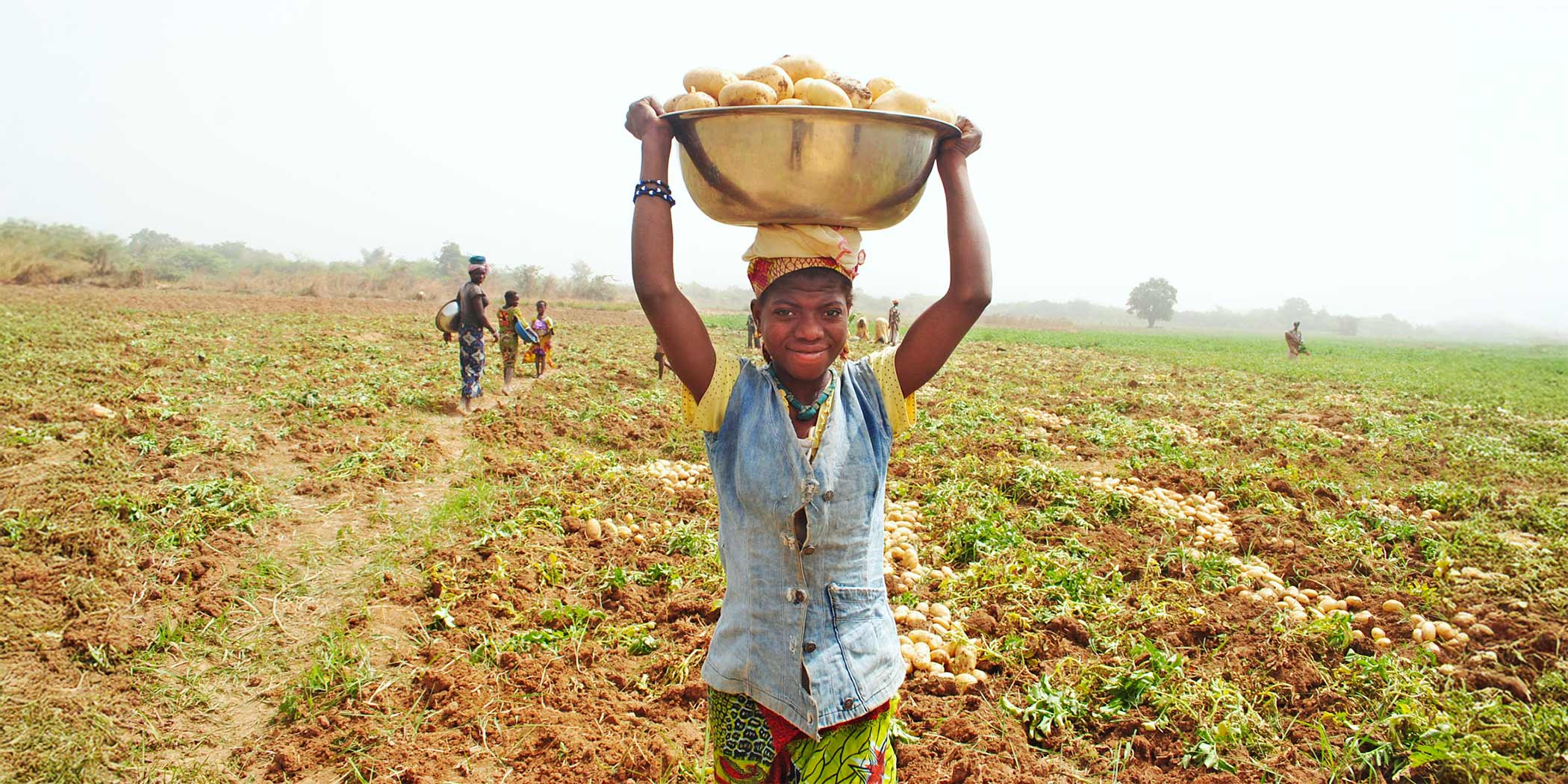
Niger is located in West Africa, with Algeria to its northwest and Nigeria to its south. The country's total land area is 1,266,700 sq km. In comparison, it is slightly larger than Angola and nearly twice as large as the state of Texas in the U.S. The country’s climate is primarily hot, dry desert, but it is tropical in the extreme south. Of the total land area, 11 percent is utilized for cultivated crops, while no measurable amount of the total land supports permanent crops such as fruit- and nut-bearing trees. Environmental issues include overgrazing, soil erosion, deforestation and desertification. This country is populated by 15.3 million people, with 63 percent living in poverty. Niger is one of the poorest countries in the world, ranking near last on the United Nations Development Fund index of human development. It is a landlocked, Sub-Saharan nation whose economy centers on subsistence crops, livestock and some of the world's largest uranium deposits. Niger’s agriculture sector represents 39 percent of GDP, with primary exports of livestock, cowpeas and onions. Other agricultural products from Niger include cotton, peanuts, millet, sorghum, cassava and rice. The North and West Africa Division is responsible for IFDC activities in Niger.
Current IFDC Projects in Niger
- Fertilizer and Sustainable Agricultural Development (F&SAD), Ongoing
The F&SAD project improves access to, and the efficient use of agro-inputs in the West African nations of Mali, Niger and Togo. Using the Integrated Soil Fertility Management (ISFM) approach, F&SAD provides agricultural intensification support. In addition to the ISFM strategy, the project includes participatory development of technology packages and facilitation of improved linkages between farmers and input and output markets.
DONOR: International Fertilizer Industry Association (IFA)
- Marketing Inputs Regionally (MIR Plus), 2009-2013
MIR Plus is improving policy and regulatory environments in the 15 nations of the Economic Community of West Africa (ECOWAS). The project is increasing the use and efficiency of agro-inputs, improving the availability of technical and market information and using technology to link producers’ organizations with agro-dealers. The project links 2.23 million farmers to agro-dealers who will help train and supply the farmers. The project should increase maize and rain-fed rice yields by 20 percent for targeted farmers in Ghana and Nigeria, and increase irrigated rice yields in Burkina Faso, Ghana, Nigeria, Senegal and Sierra Leone by 20 percent.
DONORS: Economic Community of West African States (ECOWAS), West African Economic and Monetary Union (UEMOA), the Netherlands’ Directorate-General for International Cooperation (DGIS)
Recent IFDC Projects in Niger
- From Thousands to Millions (1000s+), 2006-2010
The 1000s+ project is improving the livelihoods of one million farm households, involving 10 million people, through the up-scaling of IFDC’s Competitive Agricultural Systems and Enterprises (CASE) approach. The farmer-led initiative, based on agribusiness cluster formation, targets Benin, Burkina Faso, Ghana, Mali, Niger, Nigeria and Togo. The project also focuses on Integrated Soil Fertility Management (ISFM), improving soil fertility through the combined use of mineral and organic fertilizers.
DONOR: The Netherlands’ Directorate-General for International Cooperation (DGIS)
- Accelerating Agribusiness in Africa – Bridge (AAA-Bridge), 2011-2012
The AAA-Bridge project was an extension of Strategic Alliance for Agricultural Development in Africa (SAADA-B) activities. The objective of AAA-Bridge was to expand IFDC activities and best practices developed in West Africa, such as the Competitive Agricultural Systems and Enterprises (CASE) solution, Integrated Soil Fertility Management (ISFM), fertilizer deep placement (FDP), fertilizer resource assessments and market information systems (MIS), into other regions of Africa. Specifically, this project expansion was designed to replicate the CASE approach and other aspects of the IFDC agribusiness model in select countries of eastern and southern Africa.
- Marketing Inputs Regionally (MIR), 2002-2008
The MIR project increased the affordability and accessibility of quality inputs for targeted smallholders in West Africa, and provided technical support and training for farmers and dealers. MIR developed regional and national regulatory frameworks, supported the advancement of farmer and agro-dealer associations, facilitated dialogue along the value chain and implemented sustainable development of the cotton agro-input sub-sector.
- Strategic Alliance of Agricultural Development in Africa (SAADA), 2006-2010
For the SAADA project, IFDC organized a strategic alliance of international non-governmental organizations to facilitate regional, national and multi-national agricultural intensification/agribusiness programs with an initial focus in West Africa – with project expansion into select countries of eastern and southern Africa. The project utilized the Competitive Agricultural Systems and Enterprises (CASE) approach for agribusiness cluster formation and Integrated Soil Fertility Management (ISFM) to increase agricultural productivity.
DONOR: The Netherlands’ Directorate-General for International Cooperation (DGIS)

Niger Information
Niger Articles
MIR Plus (Taken from IFDC Report Volume 36, No. 2)