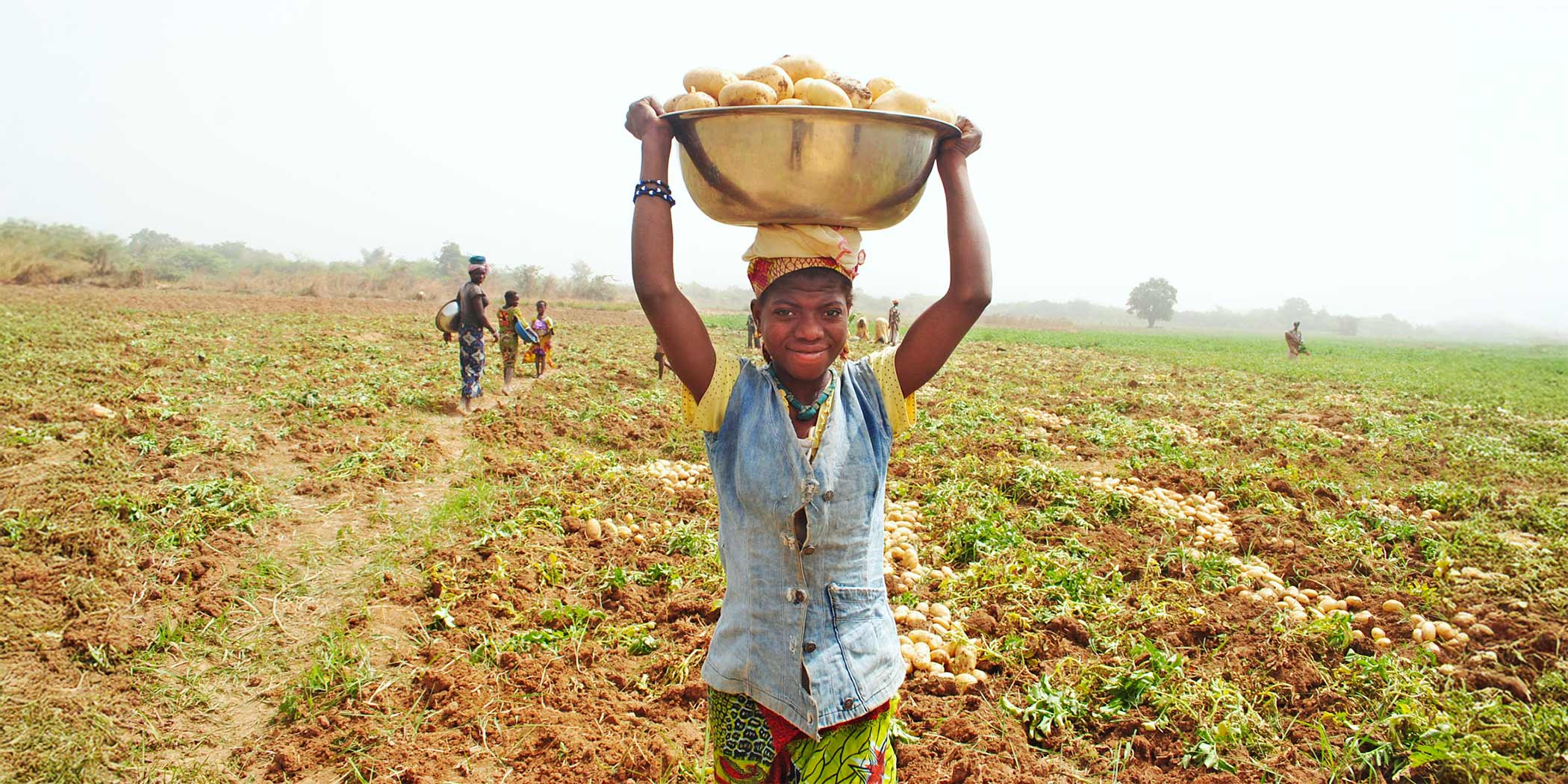

After years of conflict that ended in 1986, Uganda has experienced steady economic growth due to relative peace over the last two decades. It has one of the fastest growing economies in Africa, with sustained growth averaging 7.8 percent since 2000. However, the country’s agricultural sector has declined. In particular, northern Uganda, which bore the worst of the civil conflict, lags far behind the rest of the country in agricultural productivity, food security, economic growth and general prosperity.
Much of the northern population has lived in internally displaced person (IDP) camps for more than a decade. Technology for agricultural production, post-harvest handling and processing are outdated, and soils adjacent to the camps are depleted of critical nutrients. Farmer organizations have made some gains in the development of market linkages, but as IDPs leave the camps, maintaining the integrity of these producer groups becomes difficult. The lack of financial resources and economic infrastructure further hinder potential agricultural sector growth. These issues, combined with the lack of routinely available market information and low access to quality agro-inputs, cause most farmers to be reluctant to adopt new technologies, even when they are aware that the resulting yield improvements could provide significant increases in income.
The LEAD project is helping to raise rural agricultural productivity, incomes and competitiveness in Uganda. Under this five-year (2008-2013) USAID project, IFDC, from 2008 to 2010, provided technical support to selected farmers who grow food and cash crops. IFDC utilized the value chain approach to agricultural development, focusing on the areas of improved productivity, increased trade capacity and enhanced competitiveness.
The LEAD project uses the successful, innovative Farmer Field School (FFS) methodology. The FFS is a participatory training approach that can be considered both an extension tool and a form of adult education, or a school “without walls” for improving the decision-making capacity of farming communities. FFS consists of a group of 20-30 farmers from the same or nearby villages who meet regularly, guided by a trained facilitator during the course of a cropping cycle. The purpose is to experiment with advanced production techniques. FFS focuses on building farmers’ capacities to make well-informed decisions through increased knowledge and understanding of the agro-ecosystem.
IFDC’s technical approach to achieving results included identifying candidates for the training of trainers, targeting assistance to prioritized value chains and using Strategic Activities “Grants” Funds to stimulate the development of commercial value chains. This is a demand-driven approach in which LEAD supports grant applications solicited from the private sector and public sector partnerships. Technology transfer is accomplished at sustainable rates through the FFS while establishing and strengthening commercially oriented producer organizations.
Improved Productivity
IFDC assessed over 4,800 producer organizations. These producer organizations are located in both northern and southern Uganda, with a 60:40 distribution ratio.
The Center also conducted a broad assessment of value chains to prioritize commodity sub-sectors, as well as in-depth analyses for “fast-track” value chains including maize, rice, coffee, livestock and aquaculture. IFDC also developed protocols for staple crops. This was the first set of best agricultural procedures and practices ever developed in Uganda for staple crops.
Increased Trade Capacity
In 2008, IFDC began to sensitize producers to formal cross-border trade requirements, including moisture content and other quality and food safety issues. As a result, IFDC structured an ongoing cross-border trade agreement in millet for a buyer requiring 500 metric tons per month. Other accomplishments included the training of 42,775 farmers in cost/production and the linking of 17,303 coffee producers to exporters via training in best practices.
Enhanced Competitiveness
In September 2009, LEAD co-sponsored the Third National Competitiveness Forum, which focused on transportation infrastructure, public-private partnerships, regional integration and urbanization. Results from the forum included specific actions with assigned benchmarks, and identified those responsible for implementation. Other IFDC accomplishments included the establishment of an alliance with the International Coffee Organization (ICO) and the Uganda Coffee Traders Federation (UCTF) to unify the industry's competitiveness strategy.
Other Activities
IFDC mapped financial transaction points along several value chains. The results of the study enhanced understanding of the finance needs for select value chains. This also assisted the financial community to better understand the needs, associated risks and potential returns of lending to specific sub-sectors.
LEAD Information
Articles
IFDC Core Competency: Gender Equity is Key to Feeding the Hungry
An IFDC Core Competency: Agro-Dealer Development (Taken from IFDC Report Volume 35, No.3)