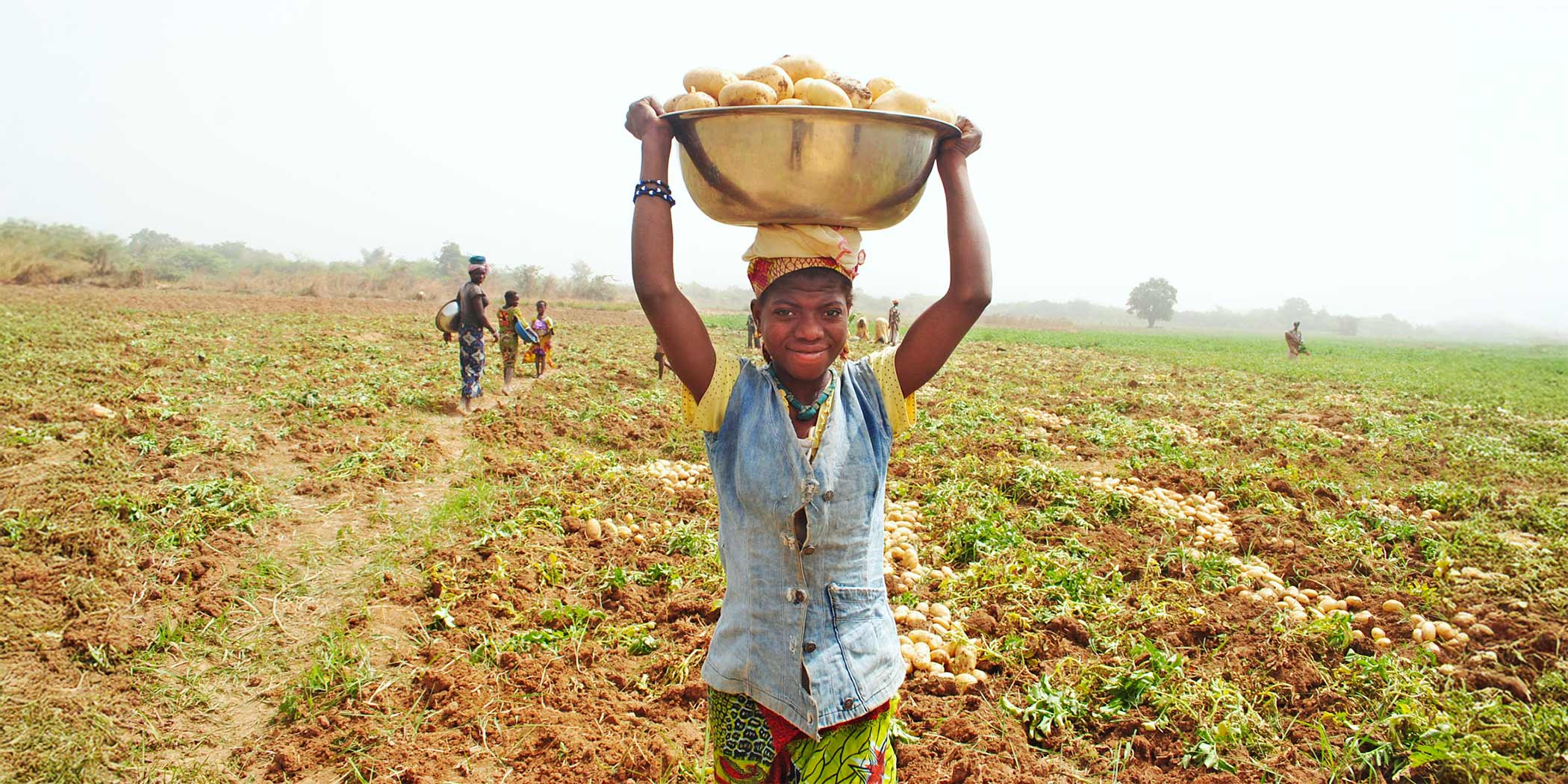
Nigeria is located in West Africa, bordering the Gulf of Guinea, between Benin and Cameroon. The total land area is 923,768 sq km. In comparison, it is slightly larger than Venezuela and nearly twice the size of the state of California in the U.S. This country's climate varies, as it is equatorial in the south, tropical in the center and arid in the north. Of the total land area, 33 percent is utilized for cultivated crops, while another three percent supports permanent crops such as fruit- and nut-bearing trees. Environmental issues facing the country are soil degradation, rapid deforestation, desertification and soil and water pollution. Oil pollution is also a concern, with oil spills causing soil, air and water pollution and further reducing arable land. Nigeria's population is over 149 million, making it the 8th most densely populated nation in the world. With 70 percent of its labor force dedicated to agriculture, 70 percent of the population also continues to live in poverty. The country has long been faced with infrastructure and macroeconomic challenges, but has undertaken several reforms over the past decade. Today, Nigeria is working to modernize its economic structure and has increased its emphasis on infrastructure improvements – working toward developing stronger public-private partnerships for electricity and roads. Nigeria’s agriculture sector represents more than 33 percent of GDP, with primary exports of cocoa and rubber. Other agricultural products from Nigeria include peanuts, palm oil, maize, rice, sorghum, millet, cassava, yams, timber and livestock. The North and West Africa Division is responsible for IFDC activities in Nigeria.
Current IFDC Projects in Nigeria
- Toward Sustainable Clusters in Agribusiness through Learning in Entrepreneurship (2SCALE), 2012-2016
2SCALE is improving rural livelihoods, nutrition and food security in Benin, Ethiopia, Ghana, Kenya, Mali, Mozambique, Nigeria, South Sudan and Uganda, with 1.15 million smallholder families ultimately increasing their productivity by 100 percent and their net incomes by 30 percent. A key component is the development of a portfolio of 500 robust and viable agribusiness clusters and value chains to supply food to regional, national and local markets and the least fortunate, also known as base-of-the-pyramid (BoP) consumers.
DONOR: The Netherlands’ Directorate-General for International Cooperation (DGIS)
- Cassava Plus, 2010-2013
Cassava Plus is a public-private partnership between IFDC and the Dutch Agricultural Development and Trading Company (DADTCO) to commercialize the cassava production of 160,000 farmers in three Nigerian states by linking them to markets more efficiently. The program assists farmers to plant, harvest and transport crops (utilizing a mobile processing unit that eliminates crop loss due to rapid deterioration). The project guarantees farmer payment for delivered crops and includes access to agro-inputs, training and new technologies. The project is expected to increase these farmers’ incomes by 22 percent.
DONOR: The Netherlands’ Directorate-General for International Cooperation (DGIS)/Schokland Fund.
- Maximizing Agricultural Revenue and Key Enterprises in Targeted Sites II (MARKETS II), 2012-ongoing
IFDC is facilitating a public-private partnership (PPP) between Notore Chemical Industries Ltd. and Nigeria’s National Program for Food Security (NPFS) to promote the use of fertilizer deep placement (FDP) technology and facilitate the supply and demand of urea briquettes in Nigeria. IFDC also is continuing to strengthen Nigeria’s fertilizer sector by improving targeted farmers’ access to agro-inputs, loaning urea briquette manufacturing machines to Notore and training the company’s workers to use the machines. Notore is distributing the briquettes via its supply channels to agro-dealers located in rice-growing regions where the project is facilitating FDP demonstration fields. Chemonics is leading the project's implementation. Collaborators include Notore Chemical Industries Ltd. and NPFS.
DONORS: Nigeria’s National Program for Food Security (NPFS) and the U.S. Agency for International Development (USAID)
- Marketing Inputs Regionally (MIR Plus), 2009-2013
MIR Plus is improving policy and regulatory environments in the 15 nations of the Economic Community of West Africa (ECOWAS). The project is increasing the use and efficiency of agro-inputs, improving the availability of technical and market information and using technology to link producers’ organizations with agro-dealers. The project links 2.23 million farmers to agro-dealers who will help train and supply the farmers. The project should increase maize and rain-fed rice yields by 20 percent for targeted farmers in Ghana and Nigeria, and increase irrigated rice yields in Burkina Faso, Ghana, Nigeria, Senegal and Sierra Leone by 20 percent.
DONORS: Economic Community of West African States (ECOWAS), West African Economic and Monetary Union (UEMOA), the Netherlands’ Directorate-General for International Cooperation (DGIS)
- Nigeria Voucher Program, 2009 – ongoing
The Nigeria fertilizer voucher program enables farmers to obtain quality agro-inputs in a timely fashion (using vouchers in lieu of cash), while also helping to build the businesses and professionalism of rural agro-dealers. By the end of 2010, more than 600,000 smallholder farmers in five Nigerian states will have received vouchers. Crops targeted for increased production include maize, rice, yam, sorghum, cassava, soybean and millet. The project also works to strengthen Nigeria’s private sector fertilizer supply and distribution channels.
DONORS: U.S. Agency for International Development (USAID), Alliance for a Green Revolution in Africa (AGRA), Nigerian National Food Reserve Agency (NFRA)
Recent IFDC Projects in Nigeria
- Accelerating Agribusiness in Africa – Bridge (AAA-Bridge), 2011-2012
The AAA-Bridge project was an extension of Strategic Alliance for Agricultural Development in Africa (SAADA-B) activities. The objective of AAA-Bridge was to expand IFDC activities and best practices developed in West Africa, such as the Competitive Agricultural Systems and Enterprises (CASE) solution, Integrated Soil Fertility Management (ISFM), fertilizer deep placement (FDP), fertilizer resource assessments and market information systems (MIS), into other regions of Africa. Specifically, this project expansion was designed to replicate the CASE approach and other aspects of the IFDC agribusiness model in select countries of eastern and southern Africa.
- Agro-Dealer Network Development (AND), 2008-2009
AND increased the capacity of agro-dealers in 10 Nigerian states (Anambra, Bauchi, Bayelsa, Cross River, Kano, Imo, Jigawa, Ondo, Sokoto and the Federal Capital Territory). The project educated and empowered extension officers who then trained 100 agro-dealers in each of the 10 states (a total of 1,000 agro-dealers) over a 12-month period.
DONOR: Nigeria’s National Program for Food Security (NPFS)
- From Thousands to Millions (1000s+), 2006-2010
The 1000s+ project is improving the livelihoods of one million farm households, involving 10 million people, through the up-scaling of IFDC’s Competitive Agricultural Systems and Enterprises (CASE) approach. The farmer-led initiative, based on agribusiness cluster formation, targets Benin, Burkina Faso, Ghana, Mali, Niger, Nigeria and Togo. The project also focuses on Integrated Soil Fertility Management (ISFM), improving soil fertility through the combined use of mineral and organic fertilizers.
DONOR: The Netherlands’ Directorate-General for International Cooperation (DGIS)
- Combating Soil Fertility Decline to Implement Smallholder Agricultural Intensification in Sub-Saharan Africa (CSD-ISFM), 1996-2004, 2006-2009
The CSD-ISFM project promoted a holistic natural resources management (NRM) approach to agricultural intensification and provided technical backstopping to IFAD projects in Sub-Saharan Africa. The Integrated Soil Fertility Management (ISFM) program was central to improved NRM, and offered such advancements as combined soil and water conservation, soil amendments, agro-forestry and mineral fertilization to create a variety of highly effective production systems across many agro-ecological zones.
DONOR: Tropical Soil Biology and Fertility Institute of the International Center for Tropical Agriculture (TSBF-CIAT)
- NEPAD-FAO Fertilizer Subsidy Study, 2011-2012
The New Partnership for Africa’s Development (NEPAD) Planning and Coordinating Agency (NPCA) commissioned this study on fertilizer subsidy programs in eight African countries, with technical guidance and financial support provided by the Food and Agriculture Organization (FAO) of the United Nations, Alliance for a Green Revolution in Africa (AGRA) and IFDC. The study is an overview of different subsidy models, thus providing a menu of best practices for countries considering ‘smart’ subsidies or wishing to alter ongoing subsidy programs. The study focuses on fertilizer subsidy programs in Burkina Faso, Ghana, Malawi, Nigeria, Rwanda, Senegal, Tanzania and Zambia.
DONORS: Food and Agriculture Organization (FAO) of the United Nations, Alliance for a Green Revolution in Africa (AGRA)
- Nigeria Agro-Dealer Support (NADS) Project, 2008-2011
NADS provides credit and support to rural agro-dealers across Nigeria. IFDC works with local partners to build dealer capacity and strengthen technical and business knowledge. The project supports trade associations and assists agro-dealers to access investment capital through risk-sharing. Dealers are also trained to provide services such as field demonstrations, soil testing and teaching best practices to farmers.
DONOR: Alliance for a Green Revolution in Africa (AGRA)
- Maximizing Agricultural Revenue and Key Enterprises in Targeted Sites (MARKETS), 2005-2010
The MARKETS project is helping to transform Nigerian subsistence agriculture into a commercially competitive market. IFDC’s role is to improve the agro-input supply system and increase the sale of improved seeds, fertilizers and crop protection products. IFDC is also creating networks of trained agro-dealers while developing input markets to create stronger value chains.
DONOR: Chemonics, U.S. Agency for International Development (USAID)
- Marketing Inputs Regionally (MIR), 2002-2008
The MIR project increased the affordability and accessibility of quality inputs for targeted smallholders in West Africa, and provided technical support and training for farmers and dealers. MIR developed regional and national regulatory frameworks, supported the advancement of farmer and agro-dealer associations, facilitated dialogue along the value chain and implemented sustainable development of the cotton agro-input sub-sector.
- Rice Emergency Initiative, 2009-2010
The Rice Emergency Initiative was created, in part, to boost rice production in Ghana, Mali, Nigeria and Senegal in order to mitigate potential shortages of this staple crop. The program targets 10,000 rice farmers in each of the nations and aims to boost total domestic rice production by 30,000 tons of paddy rice. IFDC is also improving access for the 40,000 farmers to certified rice seed and quality fertilizer.
DONOR: Africa Rice Center, U.S. Agency for International Development
- Strategic Alliance of Agricultural Development in Africa (SAADA), 2006-2010
For the SAADA project, IFDC has organized a strategic alliance of international non-governmental organizations to facilitate regional, national and multi-national agricultural intensification/agribusiness programs with an initial focus in West Africa – with project expansion into select countries of East and southern Africa. The project utilizes the Competitive Agricultural Systems and Enterprises (CASE) approach for agribusiness cluster formation and Integrated Soil Fertility Management (ISFM) to increase agricultural productivity.
DONOR: The Netherlands’ Directorate-General for International Cooperation (DGIS)
.aspx)
Nigeria Information
Nigeria Articles
MIR Plus (Taken from IFDC Report Volume 36, No. 2)