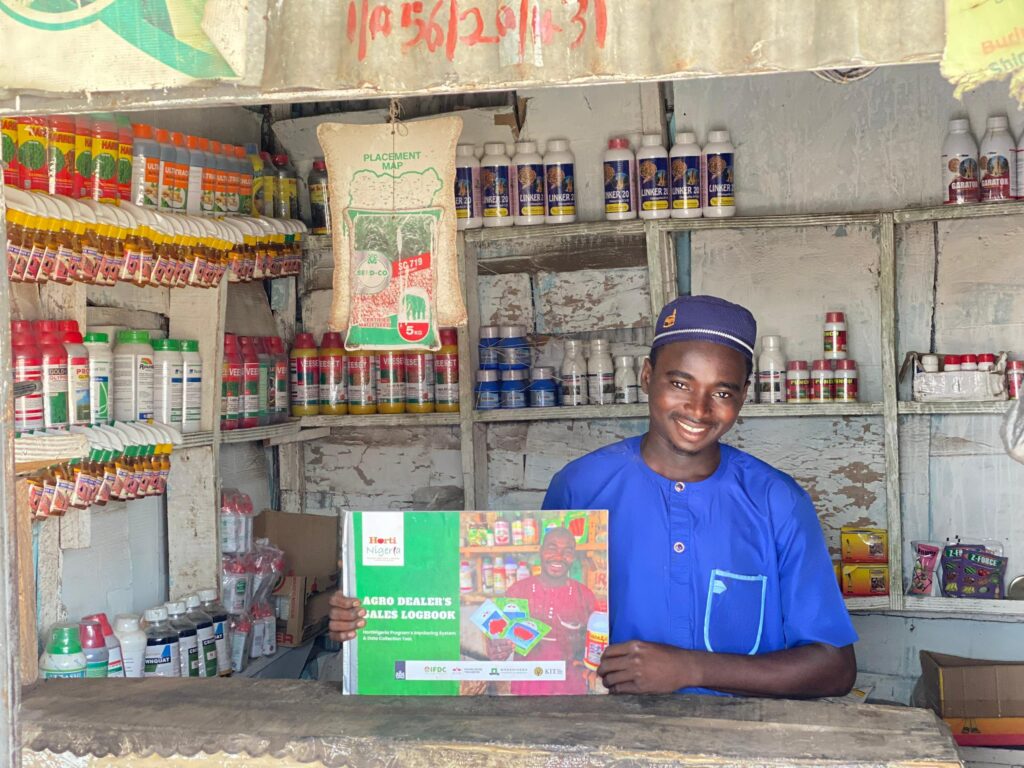
For many smallholders, entrepreneurial farmers, and agro-input dealers in Nigeria, one of the least visible yet most critical barriers to growth has long been the absence of proper record-keeping.
Without accurate records, farmers struggle to track production costs or measure profits, while agro-dealers face challenges monitoring sales, managing inventory, and proving their creditworthiness when seeking loans.
By fostering a culture of record-keeping, HortiNigeria is strengthening financial literacy and laying the foundation for more resilient, business-minded farmers and agro-dealers.
To close this gap, HortiNigeria integrated record-keeping training into its financial inclusion efforts across its implementation states. These sessions went beyond theory, equipping participants with simple, practical tools to track income, expenses, input use, and sales.
Farmers learned to log planting dates, input costs, yields, and revenues, while agro-dealers practiced techniques to manage stock, monitor cash flow, and document customer credit.
The impact has been immediate. Farmers who once operated blindly now have clear insights into their businesses.
“Before, I never knew exactly how much I was making. After HortiNigeria’s training, I started writing down my costs and sales. Now, I know my profit and I can show this to a bank when I need a loan,” shared Saidu Yakubu, a farmer in Kano State.
Agro-dealers, too, are seeing the benefits. Ifeoluwa Oyeyemi, an agro-input dealer from Kano, explained: “With proper stock records, I can see which products move fastest and which ones need promoting.”
This discipline is also unlocking new financial opportunities. Banks and microfinance institutions, once hesitant to lend, are now more willing to work with farmers and dealers who present reliable records.
As Friday Nwokolo, Head of Business Development at FCMB Microfinance Bank, observed: “When a farmer or dealer shows us their records, it improves the confidence we have in the business. Lack of documentation has always been a challenge in this sector. With proper records, we can see their capacity to repay, and that changes everything.”
By fostering a culture of record-keeping, HortiNigeria is strengthening financial literacy and laying the foundation for more resilient, business-minded farmers and agro-dealers. This seemingly simple practice is transforming how agripreneurs operate—helping them grow stronger, act more transparently, and connect to new opportunities across the horticulture value chain.
HortiNigeria (2021-2025) is implemented through a consortium led by IFDC that includes East-West Seed Knowledge Transfer (EWS-KT), Wageningen University and Research (WUR), and KIT Royal Tropical Institute and is funded by the Embassy of the Kingdom of the Netherlands in Nigeria.