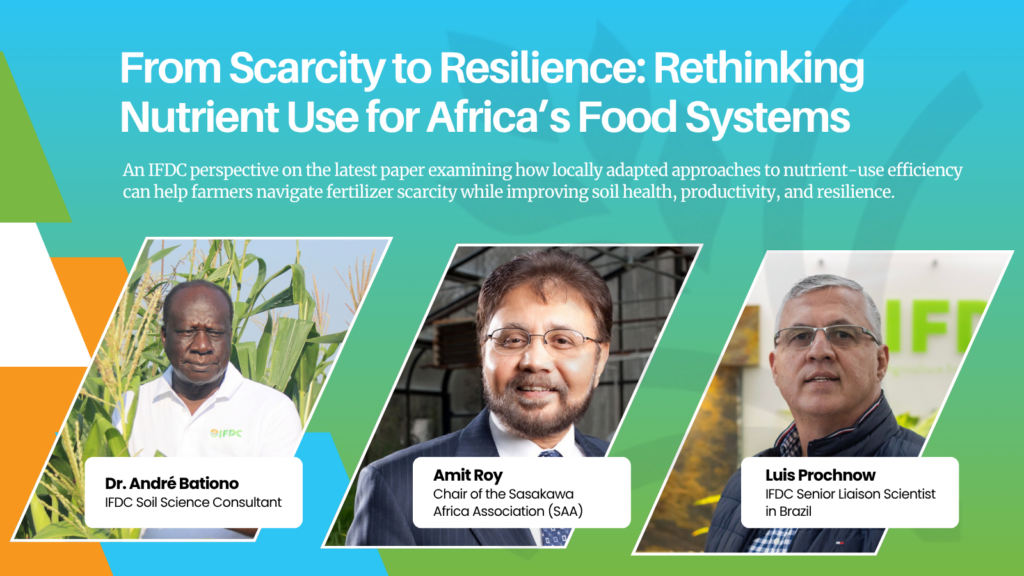
A recent research paper entitled “Lessons from low- and middle-income countries to improve nutrient-use efficiency under fertilizer scarcity” by André Bationo, Luis Prochnow, and Amit Roy offers a timely response to the challenges farmers in these regions face as they work to produce more food on more degraded land, even as access to fertilizer and other essential inputs grows less reliable and more expensive.
The paper makes an important point: fertilizer scarcity does not have to result in yield collapse.
Amit Roy, Chair of the Sasakawa Africa Association (SAA), explained: “As geopolitical disruptions make fertilizers increasingly unaffordable for poorer countries, the urgent task is not simply to apply less, but to make every available nutrient work harder through efficient, locally adapted practices.” Localized solutions can maximize nutrient sources for better yields while improving soil health over time.
This article is an IFDC perspective, considering the paper’s findings as practical lessons for the larger task of transforming African food systems. The research reinforces IFDC’s focus on connecting improved soil health and nutrient use efficiency (NUE) with functioning markets, enabling policies, locally appropriate technologies, and farmer-centered delivery systems, as shown in the three strategic goals found in IFDC’s new Strategy 2026-2035.
“The future of global agriculture and food security will depend not only on increasing access to and affordability of fertilizer, but on using all available nutrient more efficiently.”
Henk van Duijn, IFDC President and CEO
Feed the Soil: Innovations Rooted in Soil Health
IFDC’s first strategic goal, Fertilizer Innovation, recognizes that healthy soils are the foundation of farm productivity, profitability, and resilient food systems. Farmers cannot sustainably increase production where soils are depleted, lack organic matter, retain little water, or cannot make applied nutrients available to crops.
“Sixty percent of soils in Africa are degraded. It is urgent to adopt scientific technologies to restore productivity,” urged Soil Scientist Bationo.
Bationo, Prochnow, and Roy’s findings encourage putting this principle into practice. Rather than promoting one-size-fits-all nutrient use, the evidence points toward balanced fertilization, addressing deficiencies not only in nitrogen, phosphorus, and potassium, but also in secondary nutrients and micronutrients (e.g., sulfur, zinc, boron) that often go unaddressed yet limit crop response just as severely.
However, what works in one field or region will not necessarily work in the next.
“For every set of conditions, there is a best set of management options to sustain food security as best as possible – even under conditions of scarcity. Identifying and implementing those options requires evidence-based agriculture,” said Prochnow, IFDC Senior Liaison Scientist in Brazil.
Local adaptation therefore means recognizing that no single nutrient source fits every context. Mineral fertilizers, organic resources, and organo-mineral combinations each have a role to play, and the most effective approach often combines them based on what soils, farmers, and markets can realistically support, accounting for a given area’s soil conditions, cropping systems, and available resources.
Bationo, Prochnow, and Roy’s recent publication is also grounded in the established 4R Principles of Nutrient Stewardship: right source, right rate, right time, and right place. The 4Rs are a fundamental approach to fertilizer use that helps improve fertilizer efficiency, reduce nutrient losses, protect the environment, and strengthen farm profitability.
IFDC builds on the 4R principles with its 8R framework. The additional four Rs include recycle (making wastes into useful nutrient sources), rebuild (restoring soil organic carbon and microbial activity), record (supporting advisory services with data), and resilient (reducing nutrient losses through climate-smart scheduling and shock-resilient practices), which broaden the framework from fertilizer management to a more complete soil and food-system approach.
Fuel the Farmer: Make Innovations Accessible and Profitable
IFDC helps translate nutrient science into practical decisions through its second strategic goal, Farmer Impact at Scale. Innovation creates impact only when farmers can access it, understand it, and see a clear return.
Bationo, Prochnow, and Roy discuss practical fertilizer solutions built around targeted applications of smaller volumes, such as fertilizer microdosing (applying fertilizer in small amounts directly into planting holes) and urea deep placement (placing urea briquettes deep in the soil for ongoing nitrogen supply).
Bationo, Prochnow, and Roy discuss another strategy to make the most of local materials: expanding the use of indigenous phosphate rock where agronomically appropriate, while promoting good agricultural practices that improve NUE.
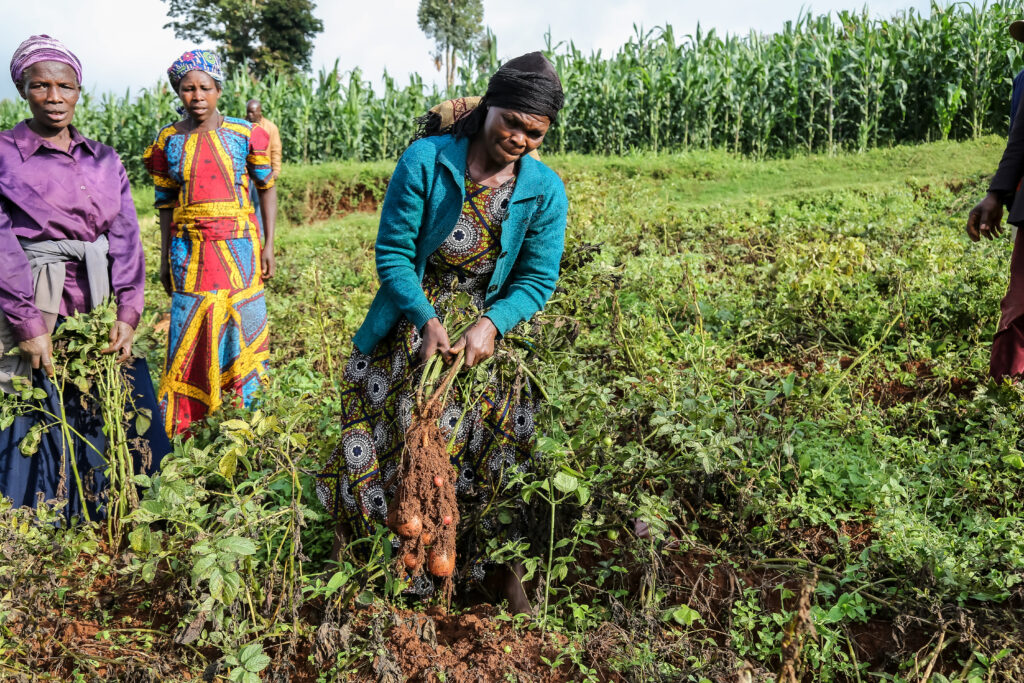
Even when processing is called for, local phosphate rock products are more affordable than imported phosphate fertilizers.
These strategies lower up-front costs compared with blanket fertilizer use, reduce the financial risk of a poor harvest, and increase returns from the limited land, labor, and capital many smallholders have to work with. They help ensure that scarce resources go toward the nutrient sources, blends, rates, and application methods most likely to improve crop response, profitability, and soil health.
Emphasizing the importance of utilizing local resources like phosphate rock, IFDC President and CEO Henk van Duijn stated, “The future of global agriculture and food security will depend … on using all available nutrients more efficiently. Recirculation of locally available nutrients and pairing improved nutrient use efficiency with healthy soils, functioning markets, and farmer-centered solutions can strengthen national and global food security and resilience for generations to come.”
Foster the Future: Build Systems that Turn Innovation into Scale
IFDC’s third strategic goal, Sustainable Systems Transformation, aims to strengthen market systems, improve regulatory frameworks, and enhance knowledge ecosystems. Scaling strategies must extend beyond the lab and farm to the financial systems that determine whether smallholder farmers can obtain fertilizer in the first place.
Bationo, Prochnow, and Roy conclude that financial strategies are necessary to scale the NUE solutions they present. They suggest that countries expand access to finance through tools such as inventory credit systems, which allow stored agricultural commodities or fertilizer stocks to serve as collateral for credit.

Revolving funds and other locally managed financing mechanisms can provide farmers, cooperatives, and agro-dealers with the working capital needed to purchase inputs at the right time rather than after planting windows have passed.
IFDC supports policies aimed at reducing barriers that raise the cost of moving inputs to rural areas, strengthening the capacity of local agro-dealer networks, and protecting farmers from counterfeit or poor-quality products. More stable and transparent markets for both agricultural inputs and farm outputs will give smallholders greater confidence to invest in improved practices.
From Evidence to Transformation
Bationo, Prochnow, and Roy indicate that fertilizer scarcity does not have to lead to lower yields or weaker food security. When nutrients are matched to local soils, crops, water conditions, and farmer realities, even limited inputs can deliver stronger harvests, better returns, and fewer losses. Productivity, profitability, and environmental stewardship are not competing goals; they can advance together.
The research indicates that healthy soils and context-specific nutrient solutions that farmers can access are the foundation of sustainable production, and the surrounding systems must be strong enough to carry proven approaches beyond projects and into lasting, scalable impact. This is what IFDC’s 10-year strategy aims to accomplish.