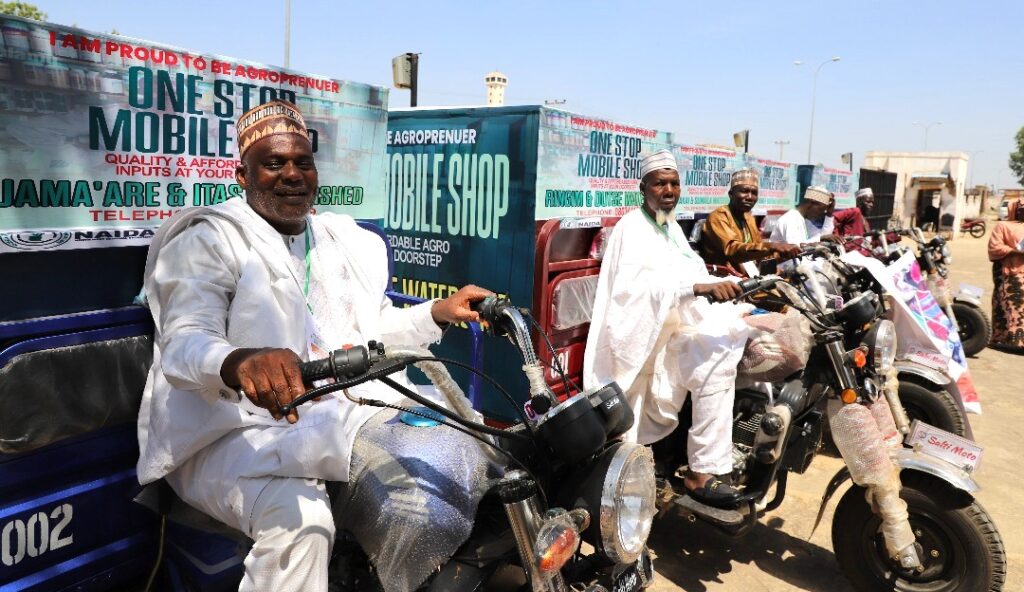
For years, farmers across the Yartiti and Fajewa watersheds in northern Nigeria faced a recurring challenge. Finding quality agricultural inputs often meant farmers had to travel long distances to major towns, spending additional time and money on transportation. In the end, low-quality products might still be all they could obtain.
These challenges were familiar to Muhammad Auwal, Executive Secretary of the Nigeria Agro-Input Dealers Association (NAIDA) for the North-West Region. “In the past, farmers in our area struggled to obtain inputs, especially high-quality ones, and could only do so in the regional capitals; this situation impeded farmers’ access to high-quality inputs and good harvests,” Muhammad explained.
Through his work with agro-input dealers and farming communities, Muhammad also witnessed firsthand how limited access to quality products constrained agricultural productivity across rural areas. “Farmers were using expired and substandard inputs sold by dealers in rural markets, which also led to soil degradation, a loss of fertility, and a decline in food production,” he added.
NAIDA’s partnership with the Soil Values program sought to address these challenges. Together, NAIDA and Soil Values introduced One-Stop Mobile Shops – mobile retail outlets designed to bring certified agricultural inputs and advisory services directly to last-mile users in farming communities. Through the Soil Values program, NAIDA members received training on sustainable soil fertility management, good agricultural practices, and managing the mobile shops. These investments strengthened the capacity of local agropreneurs to serve as both input providers and trusted sources of technical advice.
No words can fully express how happy and grateful we are for the Mobile One-Stop Shop initiative.
Tasi’u Isah Taura
With the deployment of the mobile shops, NAIDA members can now reach smallholder farmers, delivering straight to their homes, at rural markets, and throughout watershed areas. “We can now provide quality agricultural inputs directly to farmers while training them on sustainable soil fertility management practices,” Muhammad confirmed.
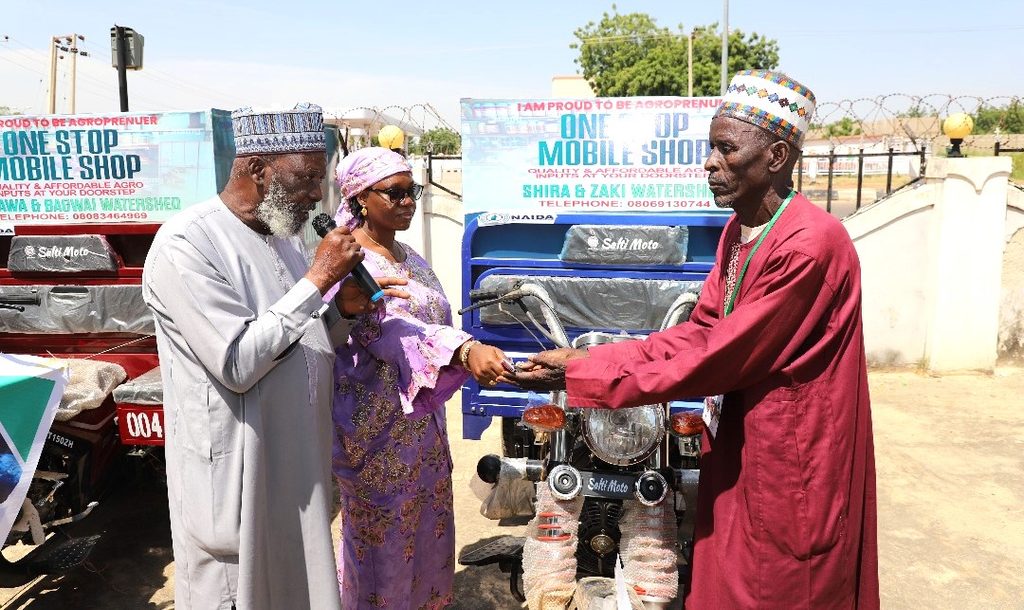
The mobile shops offer farmers much more than the agricultural products themselves; they reduce transportation costs by bringing products closer to smallholders, promote the proper use of fertilizers and crop protection products, and encourage the adoption of organic fertilizers to restore soil fertility. Service providers are also displaying their information at the mobile shops for farmers to contact them directly, strengthening trust and improving product traceability.
Halifa Haladu, a Mobile One-Stop Shop Manager, recounted his success with the initiative: “This program has enabled me to make significant progress, starting with the substantial growth of our business. Our customers – especially farmers – now place a great deal of trust in us and rely on us much more than before.” He went on to say, “Now I can stay at the market as long as necessary … This is just one of the many positive changes this program has brought to my life.”
The impact is already visible across the watersheds. Since implementation began in 2025, 25,909 farmers were trained by mobile shop personnel, including 11,203 women and 14,203 youth. Agricultural productivity increased from 1.5‑2 metric tons (mt) per hectare before the intervention to 4‑4.5 mt per hectare afterward. The initiative has also expanded access to services for women, youth, people with disabilities, and pastoralists while helping reduce the circulation of expired and low-quality inputs in rural markets.
For Muhammad, these results demonstrate the value of investing in local service providers who understand the needs of rural communities. Through support from the Soil Values program, nine agribusiness enterprises have been equipped with mobile shops and strengthened to continue delivering services well beyond the life of the program’s intervention.
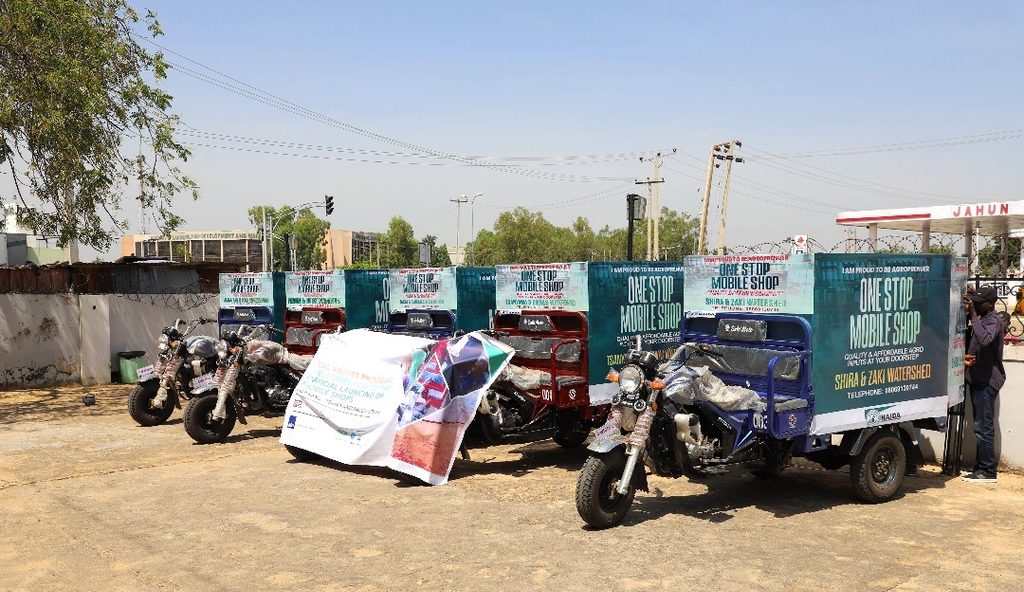
The mobile shops are also creating new business opportunities. Each agropreneur operating a mobile shop generates an average monthly income of ₦218,000 (approximately U.S. $159.79), demonstrating that sustainable soil health solutions can support both rural smallholders and rural entrepreneurs.
Tasi’u Isah Taura, another Mobile One-Stop Shop Manager, has experienced positive economic impact. “No words can fully express how happy and grateful we are for the Mobile One-Stop Shop initiative,” Tasi’u said, noting that peace of mind followed his success.
Tasi’u remarked on another major benefit of the mobile shops: building trust with smallholders they serve. “It has also elevated our status and set us apart from other merchants who sell low-quality products. Right now, farmers have complete confidence because they know that everything they buy from us is of the highest quality,” he declared.
The Mobile One-Stop Shop is improving farmers’ access to quality agricultural inputs through its network of local agricultural service centers that connect farmers to innovations, improve soil fertility, and strengthen the resilience of rural communities.
Through leaders like Muhammad and the agropreneurs like Halifa and Tasi’u working alongside him, the Soil Values program is showing that bringing services closer to farmers can help build a more productive and sustainable agricultural future.
Funded by the Dutch Directorate-General for International Cooperation (DGIS), the Soil Values program is being implemented over 10 years (2024-2033), led by the International Fertilizer Development Center (IFDC), in consortium with SNV and Wageningen University and Research (WUR), as well as knowledge partners such as AGRA, the Center for International Forestry Research and World Agroforestry (CIFOR-ICRAF), the International Institute of Tropical Agriculture (IITA), ISRIC – World Soil Information, and the International Water Management Institute (IWMI).