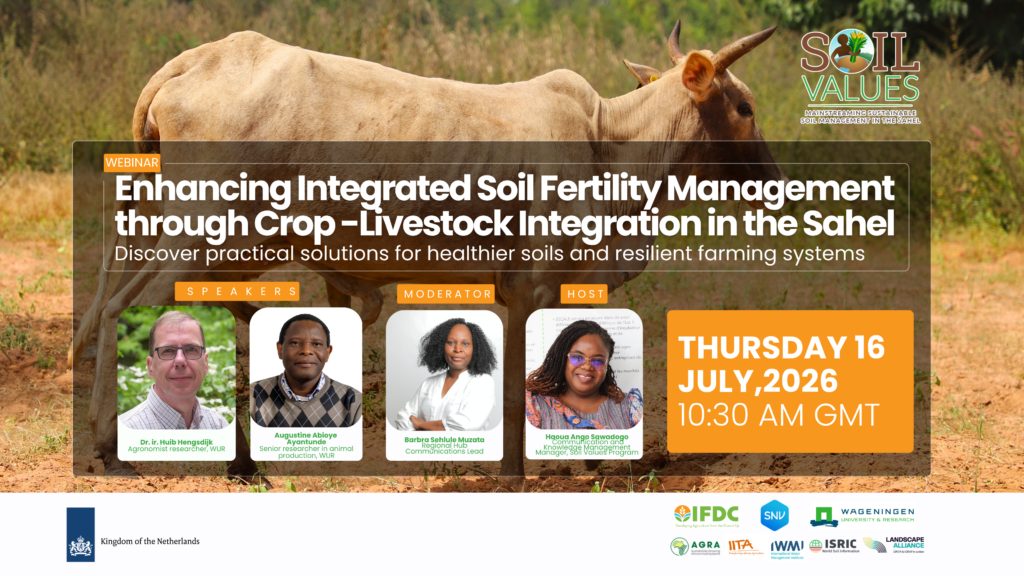
As soil degradation, shrinking grazing resources, and climate pressures intensify across the Sahel, crop-livestock integration is emerging as a practical pathway toward healthier soils, higher agricultural productivity, and more resilient rural livelihoods. A Soil Values webinar held July 16 brought together researchers, development practitioners, and field actors to examine how the region can better harness this potential while addressing the barriers that continue to limit adoption.
The webinar, entitled “Enhancing Integrated Soil Fertility Management through Crop-Livestock Integration in the Sahel,” attracted 113 participants and provided a platform to explore the technical, institutional, and policy conditions needed to strengthen integrated farming systems across the region. The webinar reflected the collaborative approach of the Soil Values consortium, uniting professional expertise and regional implementation experience to advance practical solutions for sustainable soil management in the Sahel. Contributions from Wageningen University and Research (WUR) researchers Dr. Huib Hengsdijk and Dr. Augustine Abioye Ayantunde, along with Soil Values Deputy Program Director Dr. Alimata Bandaogo, helped frame the discussion, which was moderated by Barbra Sehlule Muzata of the Regional Hub for Fertilizer and Soil Health for West Africa and the Sahel.
This approach provides a first estimate of the potential of livestock systems to contribute to crop fertilization and highlights the close links between pasture availability, manure production, and the sustainability of integrated crop-livestock systems.
Dr. Huib Hengsdijk
Manure remains an important but underutilized resource for soil fertility.
One of the webinar’s key messages was that livestock already contributes to soil fertility – but not to its full potential. Presenting evidence from Burkina Faso, Mali, and Niger, Dr. Hengsdijk explained that nitrogen comes from multiple sources, such as atmospheric deposition, mineral fertilizers, and seeds. Manure accounts for less than 20% of nitrogen inputs in these countries’ cropping systems; in other words, the amount of nitrogen contained in animal manure represents only a relatively small share of the total nitrogen input from multiple nitrogen sources.
These findings point to opportunities to improve nutrient recycling by collecting, transporting, and applying manure more effectively. However, the quantities available across the region remain insufficient to meet current crop nutrient requirements. Manure should therefore be treated as one component of integrated soil fertility management (ISFM), to be used alongside mineral fertilizers, improved crop varieties, and appropriate cultivation practices to make the most of whatever manure is available.
Dr. Hengsdijk remarked, “This approach provides a first estimate of the potential of livestock systems to contribute to crop fertilization and highlights the close links between pasture availability, manure production, and the sustainability of integrated crop-livestock systems.”
Pasture restoration is essential for successful crop-livestock integration.
More broadly, discussions during the webinar showed that stronger crop-livestock integration also depends on improving the conditions under which livestock are raised and fed. Participants emphasized that degradation of pastoral lands remains a major constraint across the Sahel while increasing pressure on natural resources and the spread of invasive species continue to reduce the availability and quality of grazing areas, limiting livestock productivity and reducing the quantity and quality of manure available for cropping systems.
Beyond strengthening livestock feed resources, healthier rangelands can strengthen the entire crop-livestock system by supporting nutrient cycling, enhancing resilience, and contributing to household food security. Restoring degraded pastures and rangeland through sustainable management therefore emerged as a critical priority. Others included improving access to high-quality feed, expanding forage production, and strengthening farmers’ capacity to apply integrated practices in ways that respond to local conditions.
Markets, organizations, and policies create opportunities for scaling integrated systems.
Stronger crop-livestock integration depends not only on technical solutions but also on management of competing demands for scarce resources, such as land, pasture, feed, and organic inputs. Crop residues, for example, are useful to livestock keepers as livestock feed, but farmers may also retain them in their fields to protect soils and add organic matter. Managing trade-offs when meeting resource needs requires coordination among farmers, livestock keepers, service providers, and public institutions. Growing trade flows between Sahelian and coastal countries were identified as an opportunity to strengthen linkages between crop and livestock value chains. Producer organizations, agro-pastoral associations, and farmer networks are playing an increasingly important role in improving coordination among stakeholders and amplifying their voices in policy discussions.
The webinar further underscored the importance of supportive national and regional policies that encourage sustainable land management practices, facilitate investment, and create incentives for integrated agricultural systems. As Dr. Ayantunde noted, stronger producer networks and enabling policies can help create the conditions needed for wider adoption of crop-livestock integration across West Africa and the Sahel.
Scaling adoption will require demonstration, financing, and local capacity.
While opportunities for integrating systems are significant, several practical barriers continue to hinder their adoption. Access to land and animals, limited manure availability, high transportation costs, and nutrient losses along transhumance routes remain major challenges.
Webinar participants wanted to know how farmers, livestock owners, and young agricultural entrepreneurs experience these barriers in practice. They sought to understand how these agricultural actors could begin integrating crop and livestock activities with limited resources, how manure quality and nutrient value could be assessed, when manure should be applied, how many animals a given area of land could support, and what forms of financing and technical assistance would make integrated systems more feasible. Participants also raised questions about the safe use of manure, including the possible transfer of weeds and plant diseases.
These practical questions reinforce the value of demonstration plots and hands-on learning. For many farmers, seeing successful examples in their own communities remains one of the most effective ways to answer some of the noted questions and encourage adoption of new practices. Dr. Bandaogo remarked of Soil Values, “We promote the combined use of organic and mineral fertilizers, as well as the establishment of demonstration plots that actively involve local communities and farmers.” These demonstration plots purposefully engage farmers and community members in testing integrated approaches under local conditions and assessing how they can be applied within their own farming systems.
Demonstration alone, however, will not be sufficient. Farmers also need practical guidance adapted to their objectives and available resources, including support on manure storage and application, livestock feeding, crop residue management, and access to appropriate inputs and finance.
The webinar also highlighted the need for sustainable business models that combine pasture restoration, forage production, financing mechanisms, and technical support services. Building local capacities and strengthening extension systems will be equally important if integrated approaches are to reach scale.
Building more resilient agricultural systems requires a systematic approach.
The webinar reinforced a growing consensus that crop-livestock integration should be understood as a system rather than a single soil fertility practice. Its potential lies in linking crop production, livestock feeding, manure management, and the sustainable use of land and other resources. When supported by complementary nutrient management strategies, restored pastoral resources, stronger farmer organizations, appropriate policies, and viable investment models, it can help make better use of local resources, strengthen cooperation between agricultural and pastoral communities, and improve resilience to climate change. Realizing this potential requires approaches that are both technically effective and practically feasible for farmers.
As countries seek pathways to restore degraded lands and strengthen food production systems, crop-livestock integration offers a promising opportunity to build healthier soils and more resilient rural livelihoods. The questions raised during the webinar are being taken forward through Soil Values country-level activities involving with local community members, two studies from doctoral students at WUR, and forthcoming WUR publications. By combining this research with the experience of farmers, practitioners, and policymakers, the program can help identify which approaches are viable in different contexts and guide where investment and support are most needed across West Africa and the Sahel.
Funded by the Dutch Directorate-General for International Cooperation (DGIS), the Soil Values program is being implemented over 10 years (2024-2033), led by the International Fertilizer Development Center (IFDC), in consortium with SNV and Wageningen University and Research (WUR), as well as knowledge partners such as AGRA, the Center for International Forestry Research and World Agroforestry (CIFOR-ICRAF), the International Institute of Tropical Agriculture (IITA), ISRIC – World Soil Information, and the International Water Management Institute (IWMI).