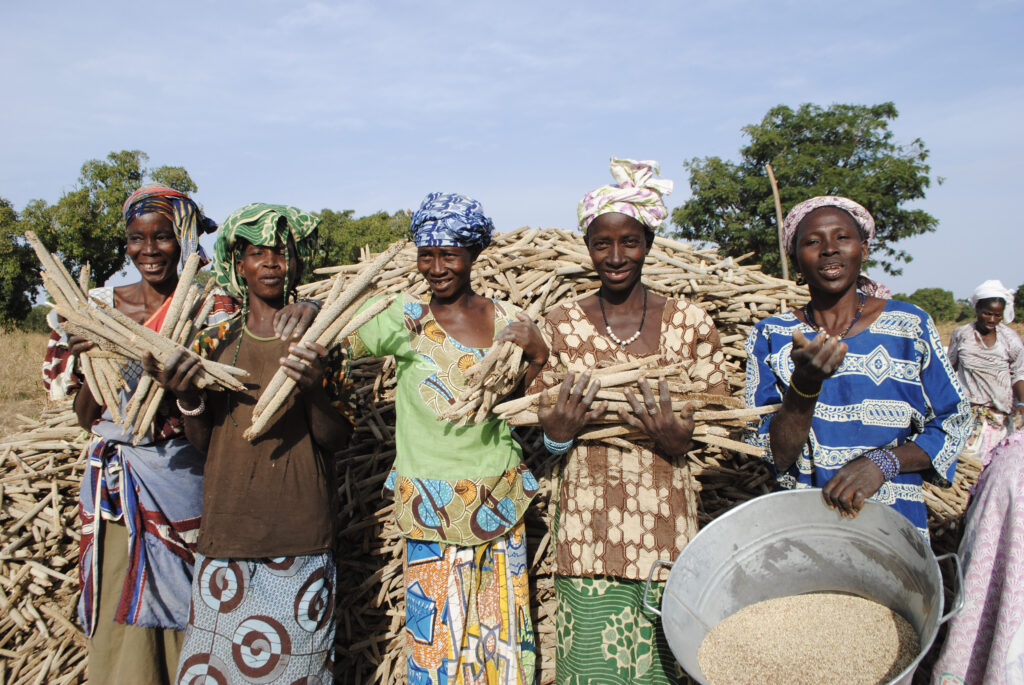
Across the Sahel, evidence increasingly shows that land restoration initiatives are more effective and sustainable when they address the barriers facing women, youth, and other underserved or vulnerable groups.
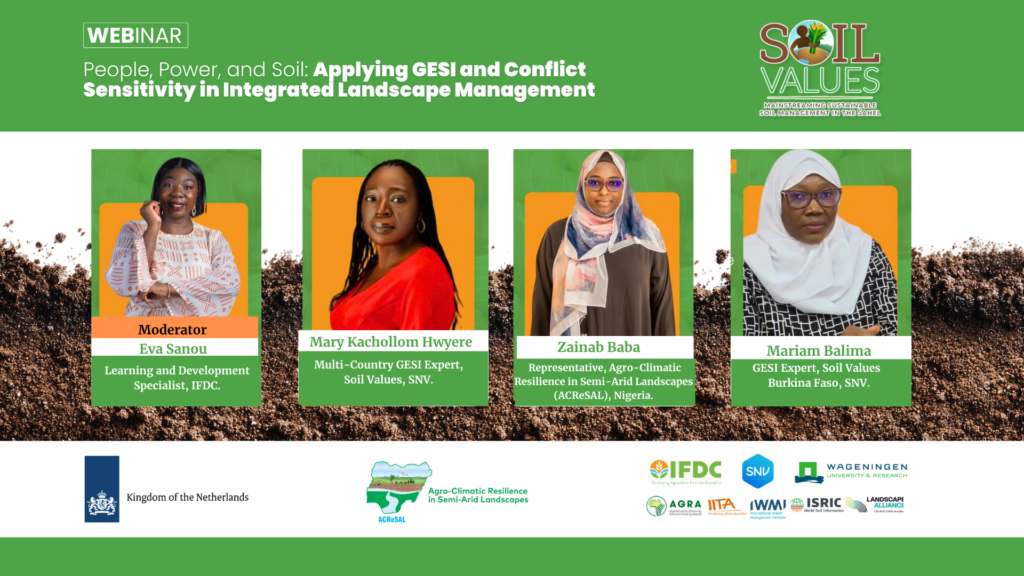
To explore ways to empower these groups, the Soil Values program hosted a bilingual (French and English) webinar on September 10 to examine how gender equality and social inclusion (GESI) and conflict sensitivity can strengthen integrated landscape management and improve development outcomes by improving access to resources, supporting inclusivity, and addressing the social dynamics that influence the sustainability of landscape interventions.
GESI is not just about ensuring that women participate. It is about asking who benefits, whose voice matters, and who may be left behind.
Mary Kachollom Hwyere, SNV’s Multi-Country GESI Expert for Soil Values
The webinar, entitled “People, Power, and Soil: Applying GESI and Conflict Sensitivity in Integrated Landscape Management,” brought together experts from Soil Values and the Agro-Climatic Resilience in Semi-Arid Landscapes (ACReSAL) program to explore how GESI principles can be translated into practice. Moderated by Eva Sanou, Learning and Development Specialist at IFDC, the discussion featured Mary Kachollom Hwyere, SNV’s Multi-Country GESI Expert for Soil Values; Mariam Balima, SNV’s GESI Expert for Soil Values in Burkina Faso; and Zainab Baba of ACReSAL Nigeria.
Making Integrated Landscape Management Work for People
Landscape restoration can generate environmental and economic benefits, but these benefits are not necessarily shared equally. Webinar participants learned that restoration initiatives can overlook customary land-use arrangements, women’s access to land, or the unequal distribution of labor if social dynamics are not adequately considered.
For example, some restoration efforts from Niger and Ethiopia unintentionally reinforced existing inequalities because power relations, access to resources, and local livelihood realities were not fully understood. These cases highlighted a fundamental lesson: measuring success solely through hectares restored, trees planted, or number of people reached can provide an incomplete picture of impact. Sustainable interventions must also consider who controls resources, who makes decisions, who benefits, and whose interests may be overlooked.
Hwyere emphasized this principle: “GESI is not just about ensuring that women participate. It is about asking who benefits, whose voice matters, and who may be left behind.” This perspective shifts attention from participation alone to the underlying power dynamics that shape who can influence decisions and benefit from restoration investments.
This principle lies at the core of Soil Values’ GESI strategy, which seeks to move beyond GESI-responsive programming toward a more transformative approach that addresses the social norms, power relations, and structural barriers that limit the agency of women, youth, and other vulnerable groups.
Moving from Participation to Real Influence and Access
Land itself is one of the most important – but unequally distributed – productive assets in rural communities. Across the four Soil Values countries of intervention (Burkina Faso, Mali, Niger, and Nigeria), women account for between 36.6% and 55% of the agricultural labor force, yet they often have less secure access to land and productive resources. In Burkina Faso, for example, women producers cultivate an average of 0.55 hectares, compared with 2.70 hectares for men.
Limited and insecure access to land affects more than gender equality. When farmers lack secure tenure, they may be less likely to invest in long-term soil health, adopt improved technologies, or access credit. Addressing these barriers is therefore essential not only for GESI outcomes but also for improving agricultural productivity, resilience, and long-term landscape results.
That is why Soil Values is working toward targets of 50% women and 30% youth across its interventions through GESI tools and accountability mechanisms, dialogue with customary leaders and financing institutions, support for land tenure security, and services adapted to the realities of women and youth.
Closing the Gap between Gender Policies and Rural Realities
Across the four Soil Values countries, gender policies and legal frameworks provide important foundations for advancing equality. Yet policy commitments do not automatically translate into secure land rights or access to agricultural inputs, finance, extension services, or decision-making opportunities for women and youth.
To return to the example in Burkina Faso, women’s more limited and less secure access to land illustrates how formal commitments can coexist with persistent structural barriers, including customary practices, weak implementation of quotas, and complex land security procedures. The webinar emphasized the importance of translating policy ambitions into tangible changes at the community level through inclusive governance, support for land tenure security, adapted financial and agricultural services, capacity strengthening, and accountability methods.
For Balima, inclusion is fundamental to sustainable development: “No development can be sustainable if part of the community is excluded. For sustainable development, we need to involve all stakeholders, women, youth, displaced people, and other vulnerable groups.” Her remarks reinforced a central message from the discussion: lasting restoration depends on ensuring that those most affected by land degradation are not excluded from decision-making or opportunities.
Building the Foundations for Inclusive Landscape Management
The webinar’s lesson can apply more broadly to the Sahel and West Africa: integrated landscape management is most effective when environmental objectives are pursued alongside inclusion, equitable resource access, and decision-making power. The experiences shared by Soil Values and ACReSAL demonstrated that real inclusion requires representation, access, voice, and influence; it requires community members to be positioned to benefit from development investments.
When all members of communities have meaningful opportunities to shape decisions and access resources, interventions are more likely to endure and deliver lasting results. By addressing the social and institutional factors that influence access to land and opportunities, Soil Values is helping lay the foundations for more inclusive landscape management and resilient agricultural systems.
The next step is to deepen this approach across other existing programs, communities, institutions, and national systems so that women, youth, persons with disabilities, people who are displaced, and other vulnerable groups are not just nominally included in soil restoration efforts but are empowered to influence and benefit from the transformation they help drive.

Funded by the Dutch Directorate-General for International Cooperation (DGIS), the Soil Values program is being implemented over 10 years (2024-2033), led by the International Fertilizer Development Center (IFDC), in consortium with SNV and Wageningen University and Research (WUR), as well as knowledge partners such as AGRA, the Landscape Alliance (CIFOR-ICRAF), the International Institute of Tropical Agriculture (IITA), ISRIC – World Soil Information, and the International Water Management Institute (IWMI).