The next fertilizer crisis is inevitable.
Whether it becomes a food crisis depends on what we invest in now.
Contact Us Today
The fertilizer market is sending mixed signals. Urea has slipped back to its January price level after spiking in April, diammonium phosphate (DAP) continues to climb, and muriate of potash (MOP) has eased from its mid-year highs. Meanwhile, fresh tensions in Egypt, Russia, China, and Europe are tightening production and global availability.
The takeaway: A falling price for one product does not mean supply risk has vanished or that farmers can suddenly afford fertilizer. What matters now is where each nutrient comes from, what trade policy says, and how much the product costs to produce.
Three Nutrients, Three Different Stories
World Bank data for October 2026 show how far apart prices for the three major fertilizers have moved this year.
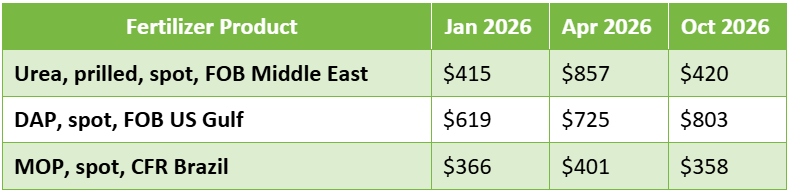
Data Source: World Bank Commodity Prices (accessed November 10, 2026).
The price of urea free on board (FOB) is down about 51% from its April peak and back near its January level. The price of DAP, however, has headed in the opposite direction, hitting U.S. $803 per metric ton (mt) in October, roughly 30% above its January level. The price of MOP, at U.S. $358/mt cost and freight (CFR), now sits just below where it started the year.
But benchmark prices are only part of the picture. Affordability also hinges on crop prices, exchange rates, financing costs, freight, inland distribution, and the timing of the purchase. Fertilizer can become cheaper on the world market and still be out of reach at the farm gate.
The number to watch is the fertilizer-to-crop price ratio; this represents how much grain a farmer must sell to buy a unit of fertilizer. When crop prices fall faster than fertilizer prices, affordability worsens, even if world fertilizer prices are flat or falling.
The European Commission’s 2026 assessment makes the point. Fertilizer-to-cereal price ratios are at their weakest since 2022, largely because cereal prices have dropped. Fertilizer costs must be considered alongside what farmers earn.
Production Constraints Are Squeezing Supply
Events in Egypt show how quickly energy shortages can hit output. On November 8, fertilizer producers saw their cut in gas supplies rise from 20% to 33%, as costly liquefied natural gas (LNG) imports strained domestic gas availability.
Abu Qir Fertilizers and Chemical Industries confirmed this cutback in gas supply from just a week earlier. Operational adjustments are keeping two of the company’s three plants at full capacity. However, the impact on total output and exports is still unclear.
Europe is facing the same cost squeeze. On November 4, Reuters reported that AGF Nitrogen, one of Europe’s largest ammonia and fertilizer producers, was running its nitrogen units at 80-85% capacity, with one line in France stopped and another running only intermittently. Expensive gas and shipping constraints linked to the Strait of Hormuz are adding pressure. The company warned that weak demand and limited storage could force further shutdowns in the coming weeks.
Phosphates face a separate problem – sulfur. China’s phosphate fertilizer exports have fallen to near zero in 2026, down from about 5.3 million mt in 2025, as tight sulfur supplies keep output at home. Export controls add to the squeeze. Countries that rely on Chinese phosphate, with few alternatives, are especially exposed.
The pattern is clear. Energy and raw material constraints are hitting different products and production hubs at the same time.
Export Policy Is Tightening the Global Supply Picture
Production is only part of the story. Government export decisions are also shaping what reaches the world market.
On November 6, Russia extended its mineral fertilizer export quotas for six months (December 1, 2026, to May 31, 2027), although the ceiling has been lowered. The total quota will be about 18.8 million mt, down from about 20 million mt for June 1 to November 30, 2026. Nitrogen fertilizers will fall from about 12.3 to 11.3 million mt, while complex fertilizers will hold steady at about 7.5 million mt.
The quotas apply to exports outside the Eurasian Economic Union. Even though these ceilings do not represent actual shipments, the cut signals Russia’s intent to balance foreign sales with domestic farm needs. Given Russia’s weight as a supplier, importers and markets should pay close attention.
China’s focus on domestic phosphate supply, backed by export controls and sulfur constraints, is another case of national market management reshaping international availability. When major producers hold back, importers must look elsewhere, and competition for available product can intensify.
Export restrictions do not always mean immediate shortages. But they leave global markets with less room to maneuver when other supply constraints are already in play.
Lower World Prices Do Not Mean Easier Access for Farmers
A farmer’s decision to buy fertilizer rests on whether the expected return justifies the cost. When crop prices fall, a farmer’s ability and willingness to buy weakens, even if world fertilizer prices are stable or falling. Uncertain rainfall and yield expectations make the decision harder still.
What This Means for Crop Production and Food Availability
For African and other import-dependent markets, the impact will vary by product and supplier. Buyers of nitrogen from Egypt or Russia face different risks from those relying on Chinese phosphate. Exchange rates, shipping routes, domestic stocks, and procurement timing will decide whether the global disruption translates to higher local prices or delayed deliveries.
That makes country-level assessment essential. Governments and market actors should track import dependence by nutrient and supplier, alongside landed and retail prices, expected arrivals, domestic stocks, and seasonal financing. Procurement and supplier diversification should follow those findings.
Fertilizer use and crop production also need closer surveillance. Price and trade data do not show whether farmers are applying less product, changing nutrient formulations, or switching crops. Tracking these shifts alongside crop prices, weather, and production is key to understanding the risk to yields and food availability.
The bottom line: Cheaper international urea should not be mistaken for a broad improvement in affordability. Urea, phosphate, and potash are moving in different directions, while energy costs, raw material shortages, and export policies continue to shape supply.
Disclaimer
This article is based on information from publicly available sources and market intelligence. While every effort has been made to verify the accuracy of the information, the authors and publishers accept no liability for any loss, damage, or disruption caused by errors, omissions, or the use of this information.
Sources