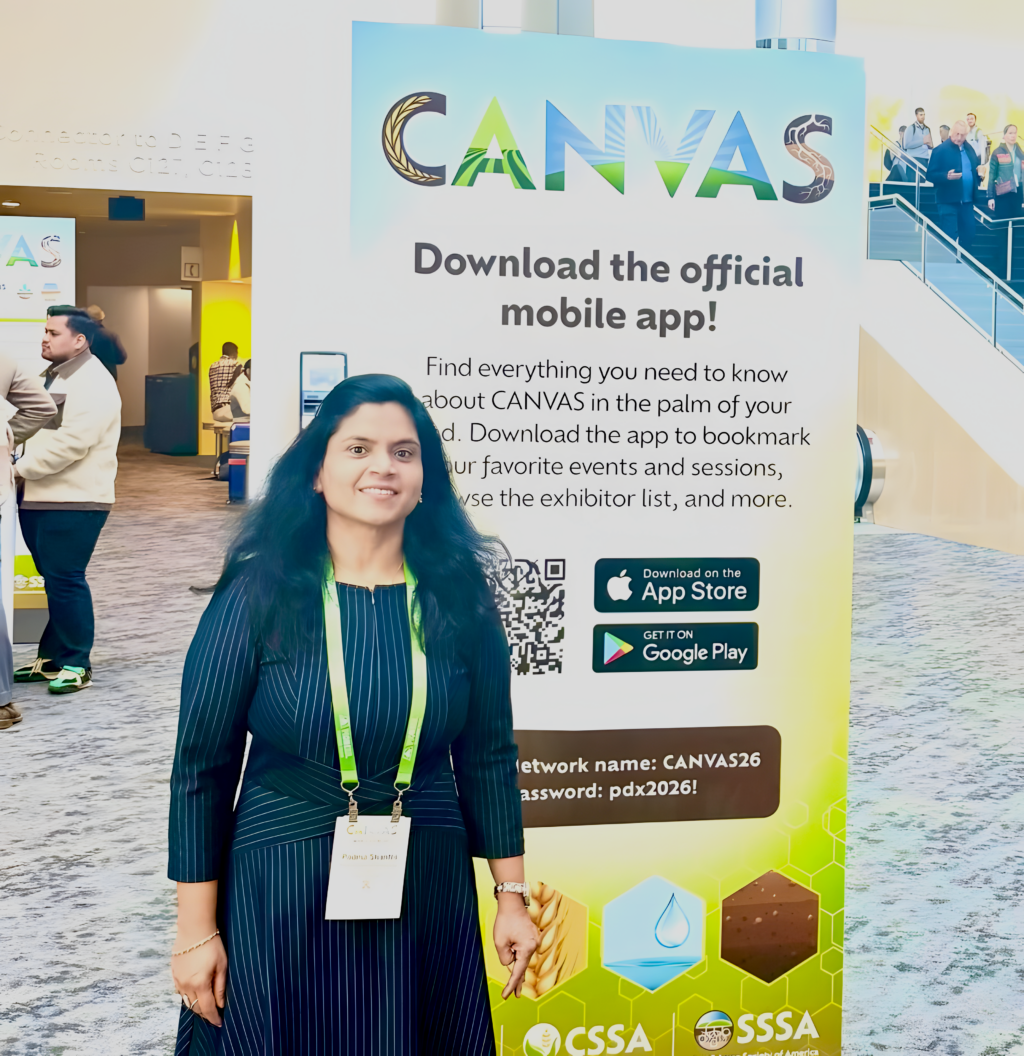
CANVAS 2026, formerly the American Society of Agronomy/Soils Science Society of America/Crop Science Society of America (ASA/SSSA/CSSA) annual international meeting, welcomed its participants November 1‑4 in Portland, Oregon.
IFDC was well represented at the meeting, featuring the research of seven IFDC scientists, five of whom presented in person, from a wide range of projects.
IFDC’s active participation and recognition marked a successful event, encouraging ongoing agricultural study and impact.
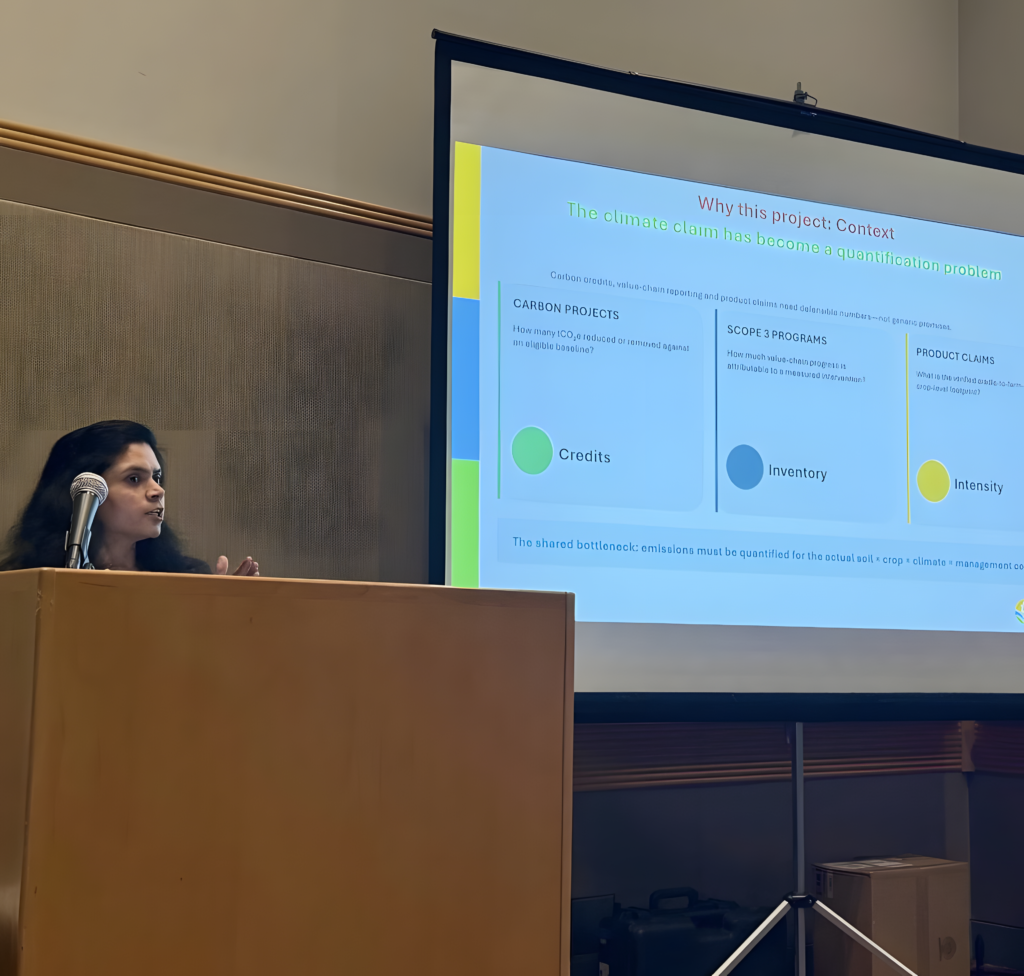
Dr. Shanthi Jagadabhi shared preliminary data analyses with her presentation, entitled “Region-Specific Modeling of Agricultural Greenhouse Gas Emissions across Diverse Soil-Crop-Climate Systems for Advancing Carbon Farming Solutions.”
She discussed how integrating field-based greenhouse gas measurements with process-based biogeochemical and crop simulation models, including DeNitrification-DeComposition (DNDC) and the Decision Support System for Agrotechnology Transfer (DSSAT), can improve the accuracy and regional relevance of emissions estimates and how the accuracy will strengthen data integrity of carbon credit markets, reduce uncertainties in carbon accounting, and improve smallholder farmers’ access to carbon finance opportunities.
In Dr. Kiran Pavuluri’s presentation, entitled “Agronomic Evaluation of Novel Green Ammonia-Based Nitrogen Fertilizers,” he discussed IFDC’s ongoing efforts to convert decentralized green ammonia into safe, affordable, and agronomically effective fertilizers suitable for smallholder farmers in sub-Saharan Africa.
He highlighted the development of novel aqueous ammonia-based fertilizer formulations using various organic and inorganic materials, including biochar, bentonite, and other locally available resources. He presented relevant findings from laboratory and greenhouse studies and outlined next steps, including further formulation optimization, development of a decision-support tool, field validation, and pilot-plant scale-up to support decentralized fertilizer production in Africa.
In “Evaluating Urea-Based Enhanced Efficiency Nitrogen Fertilizers in Sorghum-Sudangrass,” Dr. Syam Dodla discussed the agronomic performance of various enhanced-efficiency nitrogen fertilizers (EENFs), including controlled-release, slow-release, and stabilized fertilizers, under contrasting acidic and alkaline soil conditions.
He presented findings from greenhouse studies indicating that polymer-coated fertilizers generally demonstrated greater adaptability across soil conditions, while the performance of urease and nitrification inhibitors was more dependent on soil characteristics. He emphasized the importance of matching fertilizer technologies with soil conditions and crop nitrogen requirements to improve nitrogen use efficiency and crop productivity. He also highlighted how these findings could contribute to developing a decision-support tool for selecting suitable fertilizer technologies.

Additionally, retired IFDC scientist Dr. Sen Chien spoke on past IFDC studies with new sulfur (S) sources, in partnership with Dr. Elizabeth Guertal, Director of IFDC’s Laboratory of Innovations for Fertilizers in the United States (LIFe-US), in a presentation entitled “Comparison of Ammonium Sulfate and Granular (Monoammonium Phosphate + Micronized Elemental S) As S Sources for Maize Growth.”
This is part of a larger body of work that seeks to develop and study alternative sulfur sources for crop production. As sulfur fertilizer supplies become increasingly affected by global availability, this work helps to identify alternative affordable sources.
The meeting also hosted an Awards Luncheon, where Dr. Zachary Stewart, IFDC’s Vice President of Research and Development and Chief Scientist, received a significant honor: the Visionary Scientist for African Agriculture Award, sponsored by OCP North America. This award honors senior agronomic, crop, or soil scientists for significant contributions to agricultural productivity, soil health, and climate resilience across Africa. Dr. Stewart was recognized for his leadership roles, such as in convening the Africa Fertilizer and Soil Health Summit, as well as for his contributions to research and innovations such as the Space to Place initiative.
IFDC’s presentations at CANVAS 2026 contributed to sharing knowledge and expanding research, while Dr. Stewart’s award recognizes the vision and hard work to which IFDC’s scientists are dedicated. IFDC’s active participation and recognition marked a successful event, encouraging ongoing agricultural study and impact.
Presentations Cited Above
Pavuluri, K., S. Kala, I. Bak, S. Dodla, F. Davis, and S. Kalu. 2026. “Agronomic Evaluation of Novel Green Ammonia-Based Nitrogen Fertilizers,” CANVAS 2026, Portland, Oregon, November 1‑4.
Dodla, S., K. Pavuluri, L. Nagarajan, Z. Stewart, F. Davis, and S. Kalu. 2026. “Evaluating Urea‑Based Enhanced Efficiency Nitrogen Fertilizers in Sorghum-Sudangrass,” CANVAS 2026, Portland, Oregon, November 1‑4.
Jagadabhi, P.S., L. Nagarajan, and Z. Stewart. 2026. “Region-Specific Modeling of Agricultural Greenhouse Gas Emissions across Diverse Soil-Crop-Climate Systems for Advancing Carbon Farming Solutions,” CANVAS 2026, Portland, Oregon, November 1‑4.
Francisco, E., S.H. Chien, and B. Guertal. 2026. “Comparison of Ammonium Sulfate and Granular (Monoammonium Phosphate + Micronized Elemental S) As S Sources for Maize Growth,” CANVAS 2026, Portland, Oregon, November 1‑4.