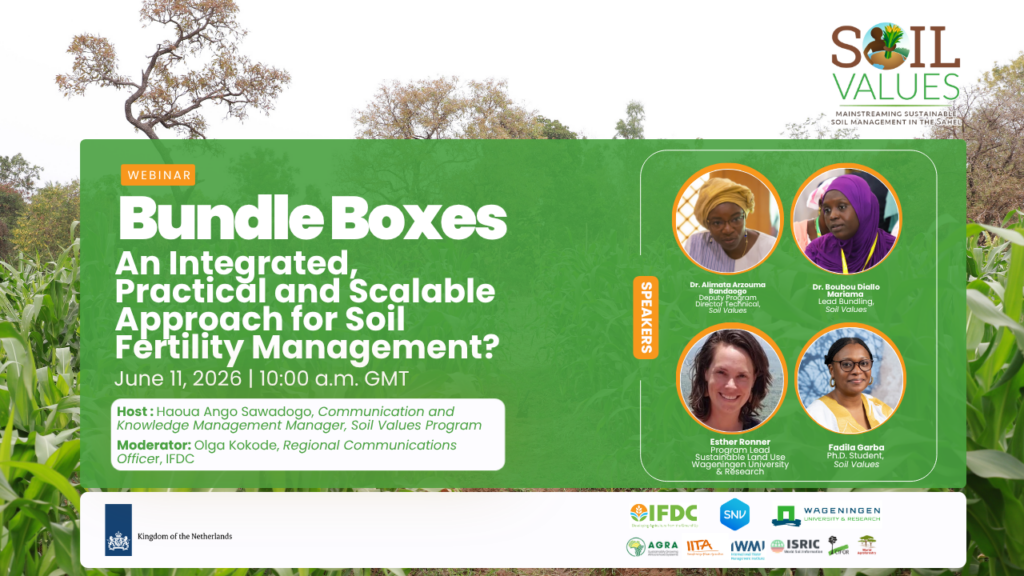
As land degradation and climate shocks continue to threaten farming systems across West Africa and the Sahel, the Soil Values program is positioning the Bundle Box as a promising way to improve soil health and fertility while boosting smallholder incomes and resilience. On June 11, Soil Values held a webinar on “Bundle Boxes: An Integrated, Practical, and Scalable Approach to Soil Fertility Management?” The 90-minute session served as a space for researchers, field practitioners, and others to explore what it will take for the approach to succeed and scale.
With around 80 participants in attendance, the discussion drew on the expertise of Dr. Esther Ronner, Sustainable Land Use Specialist at Wageningen University and Research, Dr. Alimata Arzouma Bandaogo, Deputy Program Director – Technical of the Soil Values program, and Dr. Mariama Boubou Diallo, Bundling Lead of the Soil Values program.
These bundle boxes are about removing uncertainty for all actors involved. For farmers, they ensure that investments and efforts will translate into tangible benefits. For input providers, they help improve sales and logistics by packaging services together.
Dr. Esther Ronner, Sustainable Land Use Specialist at Wageningen University and Research
According to Dr. Bandaogo, the era of fragmented agricultural interventions is coming to a close. For decades, efforts that provided seeds without fertilizer or fertilizer without market access have limited the impact of agricultural development programs. The Bundle Box approach offers a more integrated response by combining complementary services into a single package.
Dr. Diallo explained that the model brings together five core components: quality inputs tailored to local needs, including improved seeds, mineral fertilizer, and biofertilizers; sustainable practices, such as integrated soil fertility management, soil and water conservation, and crop-livestock integration; ongoing extension support; financial services; and direct access to markets.
The goal is to respond more effectively to the real-life constraints farmers face by bringing together the services and relationships needed for innovation to take hold into one package. Dr. Ronner noted: “These bundle boxes are about removing uncertainty for all actors involved. For farmers, they ensure that investments and efforts will translate into tangible benefits. For input providers, they help improve sales and logistics by packaging services together.”
To illustrate the effectiveness of these bundled packages, Dr. Ronner shared the example of Ousmane Samaké, a farmer in Mali, who lacked sufficient resources to fertilize his soybean fields. His poultry manure was too acidic, and his goats did not produce enough manure to meet his farming needs. The Bundle Box approach addressed this problem by incorporating a contractual arrangement with nomadic pastoralists passing through the area, allowing Samaké to secure access to high-quality organic manure. This example shows how a context-specific solution can involve building practical partnerships with other actors in the local system. In that sense, Bundle Boxes are designed to address the specific barriers farmers face in practice, not to just deliver products.
The webinar also underscored the importance of carefully designing the financial services built into these packages. Dr. Ronner shared findings from a study in Ethiopia showing that, in some cases, offering microcredit can actually slow adoption when farmers perceive a higher risk of debt if their harvest were to fail. The discussion made clear that access to finance on its own does not guarantee adoption. It must be part of a broader package that also reduces the risks related to production and marketing.
In Samaké’s case, reducing risks meant integrating a buyer into the package. By ensuring that a processing company would send a collector, provided that volumes and quality standards were met through improved practices and aggregation with neighboring farmers, the arrangement made market access more predictable. Integrating a buyer increased the appeal of the full package, contributing to a technology adoption rate of nearly 80% among producers.
A Model Built on Complementary Roles
The strength of the Bundle Box approach lies in its ability to create trusted relationships in which every actor has something to gain. Farmers can invest with greater confidence when they know their efforts will likely translate into returns. Input suppliers can organize logistics more efficiently by consolidating orders, and industrial buyers can secure a more reliable and standardized supply. Microfinance institutions, in turn, may see a more structured framework for supporting producers. At the same time, the long-term viability of the model depends on strong coordination so that it can become embedded in local market realities.
Research in Action, Grounded in Field Realities
The rollout of Bundle Boxes is backed by close scientific follow-up, including work led by a new generation of African researchers within the Soil Values program. Fadila Saley Garba, a doctoral student in the program, is currently conducting a comparative study across four countries in the subregion. She stressed the importance of continuous learning and the need to draw on the team’s many years of field experience. Garba shared, “Bundle Boxes are not a set-in-stone formula: they will be prototyped, tested, refined, and adjusted in the field based on feedback and community perceptions, which often explain why certain technologies are rejected.”
What It Will Take to Sustain and Scale Bundle Boxes
The webinar concluded with group discussions highlighting several major challenges related to the long-term sustainability of Bundle Boxes. Participants identified some practical priorities to ensure the approach outlasts the lifespan of the Soil Values program.
One key requirement is land tenure security, especially for women, to ensure that those working the land can benefit from the long-term returns on their investments. Another is the development of local support systems. To reduce dependence on external technicians, webinar participants recommended training lead farmers, especially young people, who can then serve as peer trainers within their own communities.
Participants also emphasized the need for transparent internal governance and fair partnerships built on a truly win-win model. Service packages should not focus solely on increasing income from cash crops; they must also address farmers’ food security and livelihood needs. More broadly, the discussion highlighted that the long-term viability of the approach will depend on strong local anchoring, not just on national policy frameworks.
The webinar also highlighted the importance of building stronger links between research, field experimentation, and dialogue with development actors. That connection is essential for capturing lessons, refining the Bundle Box approach as implementation progresses, and strengthening the prospects for scaling it across diverse contexts.
Through Bundle Boxes, the Soil Values program is advancing an integrated, practical, and adaptable response to agricultural challenges in West Africa and the Sahel. The approach relies coordination among actors, risk reduction, and strong local grounding. The webinar made it clear that the approach offers a concrete pathway to support more sustainable adoption of agricultural innovations that can improve soil fertility, strengthen food security, and build producer resilience.
Funded by the Dutch Directorate-General for International Cooperation (DGIS), the Soil Values program is being implemented over 10 years (2024-2033), led by the International Fertilizer Development Center (IFDC), in consortium with SNV and Wageningen University and Research (WUR), as well as knowledge partners such as AGRA, the Center for International Forestry Research and World Agroforestry (CIFOR-ICRAF), the International Institute of Tropical Agriculture (IITA), ISRIC – World Soil Information, and the International Water Management Institute (IWMI).