The next fertilizer crisis is inevitable.
Whether it becomes a food crisis depends on what we invest in now.
Contact Us Today
Fertilizer markets remain extremely tense because of the impacts on supply resulting from the wars in Iran and Ukraine.
Three Nutrients, Three Stories
After a price hike in July, the nitrogen market has pulled back as China’s government approved some urea exports. Overall, there appears to be less energy in the market than at the start of the Iran war; the key Middle East benchmark touched $450 per metric ton (mt) free on board (fob) at the end of July – just half the level reached during the peak in April – and has fallen by $35/mt since then.
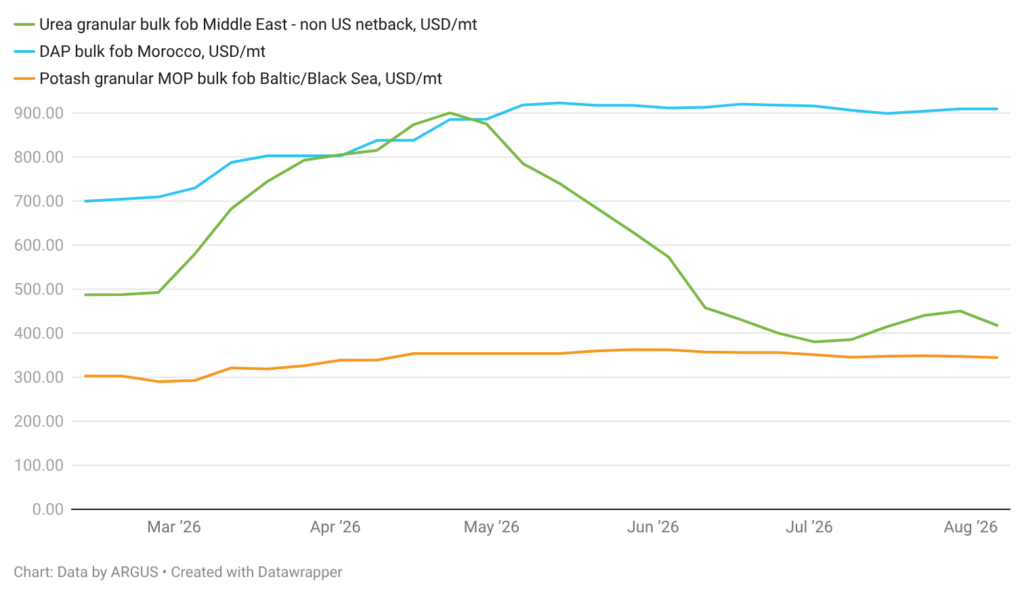
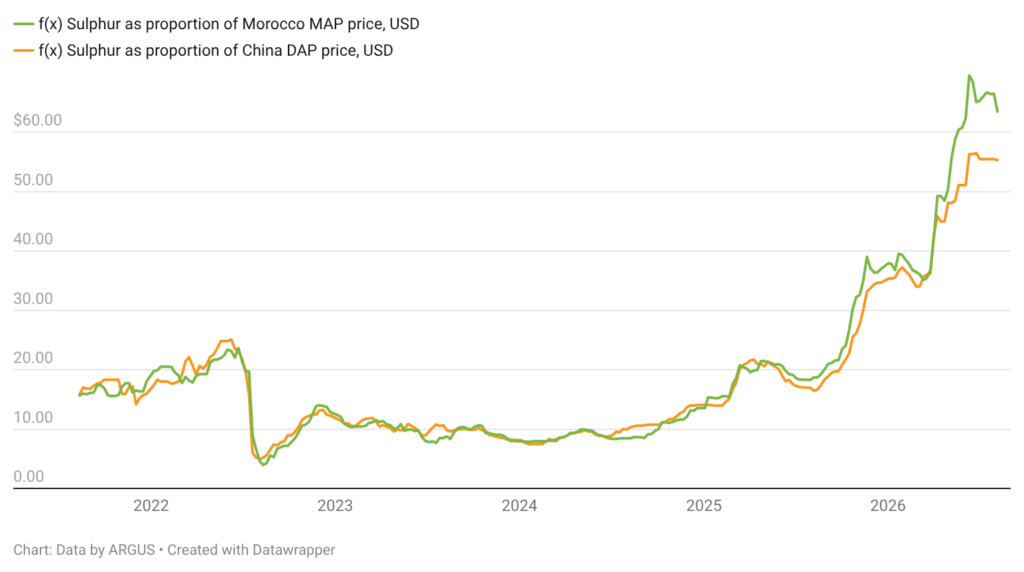
The phosphate market, however, is still in crisis. Producers continue to have limited access to raw material sulfur and are running at reduced operations or have shut down entirely. Prices skyrocketed between March and May and, unlike nitrogen, have stayed at these near-record levels ever since.
Supply from the Middle East and Russia has been significantly curtailed due to the ongoing military actions, while demand from the deeper-pocketed metals sector has continued to grow. Phosphate producers have little to no room to reduce prices until the sulfur supply increases. On a cash basis, sulfur now accounts for around 65% of the cost of producing diammonium phosphate (DAP) or monoammonium phosphate (MAP), while historically this has been between 10% and 20%.
Potash is the only note of real stability, reflecting a lack of real supply risk. Most of the world’s supply comes from Canada, Russia, and Belarus, and neither production nor shipping have been targeted in military actions. Muriate of potash (MOP) prices have risen slightly, but producers appear pragmatic and focused on minimizing demand destruction; when importers have shown resistance, suppliers have typically lowered prices rather quickly.
Argus’ Baltic fob index shows granular MOP trading in a narrow band on either side of $350/mt fob since April. Sulfate of potash (SOP), however, being largely dependent on sulfur for its manufacture, has behaved more like phosphate as its producers face similar pressures. In some markets, SOP prices have risen by more than one-third since the Iran war began in February and will likely continue to track movements in the sulfur market going forward.
Resource Nationalism on the Rise
Resource nationalism is increasingly being embedded in fertilizer markets as governments lean on major players to ensure supply. The most noticeable impacts have been from China, where exports of most fertilizers have been heavily restricted as the government seeks to maintain stable local prices by safeguarding supply.
An inverse situation has occurred in Australia as the government selected certain private companies and committed to compensate them if fertilizer prices fell after they bought cargoes.
More subtly, but perhaps with the same significance as China’s export restrictions, Russia has prevented Kazakhstan from exporting sulfur through the country in an attempt to strong-arm the country into supplying the product to Russian consumers. With sulfur markets already exceptionally tight, this further increases the difficulty in accessing sulfur-dependent fertilizers, such as phosphates, SOP, and multi-nutrient compounds.
Food security is one of the fundamental concerns of governments, and fertilizers play a vital role in maximizing crop yields. Markets have, during the last decade or so of relative stability, not faced much scrutiny as they were functioning well and remained in the background. This new state of affairs, though, adds a complication to markets and will likely further volatility.
Disclaimer
This article is based on information available from publicly available sources and market intelligence. While every effort has been made to verify the accuracy of the information, the authors and publishers accept no liability for any loss, damage, or disruption caused by errors, omissions, or the use of this information.