Read the study
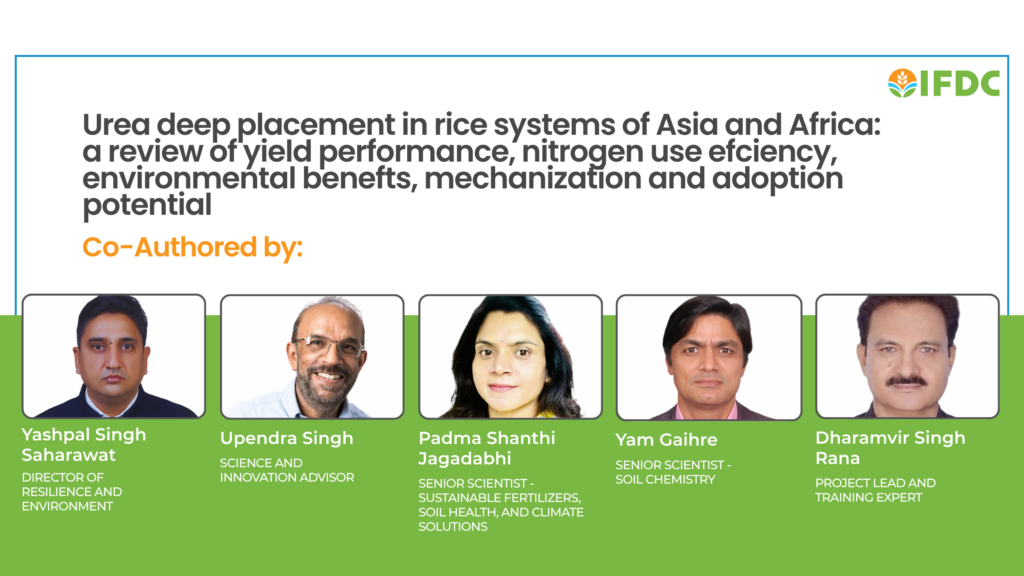
A new study published in Nutrient Cycling in Agroecosystems titled “Urea deep placement in rice systems of Asia and Africa: a review of yield performance, nitrogen use efficiency, environmental benefits, mechanization and adoption potential” examines how urea deep placement (UDP) can improve fertilizer use and rice production across Asia and Africa.
Rice farmers often rely on urea fertilizer to support crop growth, but conventional methods of spreading fertilizer can result in significant nitrogen losses before plants can use it. UDP offers an alternative by placing urea below the soil surface, closer to the plant’s roots, rather than spreading it over the soil or standing water.
The review, co-authored by IFDC scientists Yashpal Singh Saharawat, Upendra Singh, Padma Shanthi Jagadabhi, Yam Gaihre, and Dharamvir Singh Rana, analyzed findings from 34 peer-reviewed studies comparing UDP with common farmer practices.
Across the systems examined, UDP was associated with approximately 14–15% higher grain yields, a 38% improvement in agronomic nitrogen use efficiency, and a 21% increase in nitrogen recovery efficiency. The findings also indicate that UDP can achieve comparable or higher yields while requiring lower nitrogen application rates.
The review found that UDP can be particularly effective in flooded, transplanted rice systems with suitable soil and water conditions. However, the researchers emphasize that UDP is not a one-size-fits-all solution. Its effectiveness varies depending on local growing conditions.
The article notes that scaling UDP will require greater investment in affordable mechanization, context-specific fertilizer recommendations, and integrated nutrient management approaches. Strengthening fertilizer supply chains, private sector distribution, extension services, and supportive policies will also be important for sustained adoption.
Overall, the review highlights UDP as a promising, targeted approach for improving fertilizer efficiency and rice productivity in Asia and Africa. Expanding its use will depend on adapting the technology to local conditions while strengthening access to equipment, reliable fertilizer supplies, and farmer support.