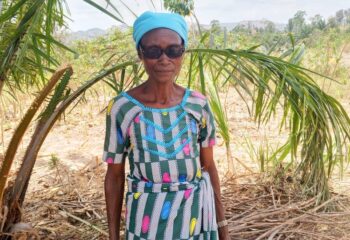
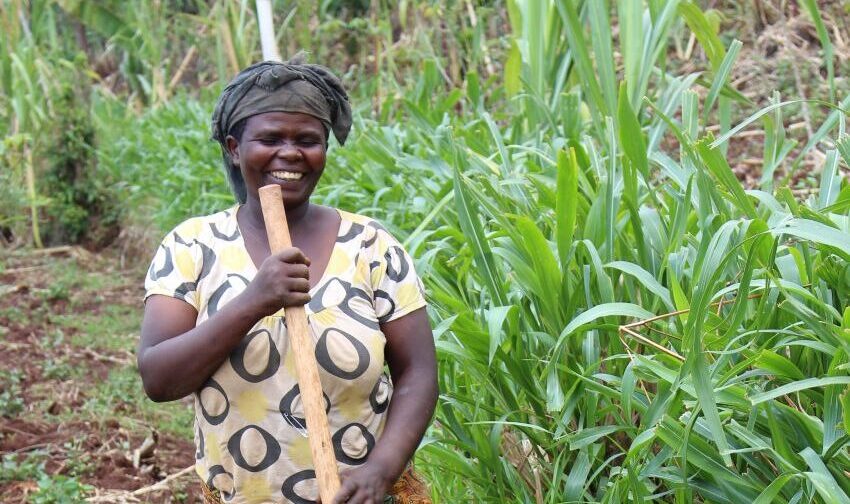
Niyimbona Anésie, a 41-year-old farmer from Nyampura, Burundi, has transformed her farming practices and livelihood through training on good agricultural practices provided by the Soil Fertility Stewardship Project (PAGRIS).
“With what I have learned and implemented thanks to the training from PAGRIS, I am very satisfied and will continue to apply it in the future.”
Niyimbona Anésie
Anésie remarked that before the training sessions, she had conducted her farming without sufficient knowledge. She often cultivated her crops by sowing seeds randomly, without proper protection or planning, and her farm had produced only enough for immediate consumption. However, everything changed after the training she received from PAGRIS.
Equipped with new knowledge, she began applying sustainable and efficient farming practices such as contour farming, planting sugarcane along the contour lines for soil protection. She also introduced intercropping with Bazooka hybrid maize and beans to create a more stable and adaptable farming system, enhancing her farm’s climate resilience.
Anésie also began using mineral and organic fertilizer to increase yield, applying dolomite to enhance soil health, and improving her weeding practices to promote healthier crop growth. These changes resulted in a remarkable increase in productivity.
From sowing just 1 kilogram of Bazooka maize seeds and 1.5 kilograms of beans, she harvested 200 kilograms of maize and 250 kilograms of beans, whereas prior to training, planting 8 kilograms of bean seeds on the same plot had yielded only about 40 to 50 kilograms.
Inspired by her success, Anésie trained 15 neighboring farmers, all of whom have started applying the techniques she shared. They have since reported similar improvements in their yields after establishing standard Integrated Plot Plans (IPPs) on their farms, allowing them to experiment with the multiple agricultural practices from Anésie.
Anésie’s financial impact has been equally impressive. She sold 40 kilograms of beans at 4,000 Burundian francs (BIF) per kilogram (approximately U.S. $1.34 per kilogram), earning 160,000 BIF (approximately U.S. $53.79).
The soil-protecting sugarcane she had planted in her contouring practice became a commercial crop, which she sold for 500,000 BIF (approximately U.S. $168.06). With this income from just one growing season, she has covered her daughter’s school fees, paid labor costs, and invested in livestock, purchasing four goats and two cows.
“With what I have learned and implemented thanks to the training from PAGRIS, I am very satisfied and will continue to apply them in the future,” Anésie declared.
Anésie, who is a wife and a mother of one daughter, is also a community role model, serving as a PAGRIS committee member at the Nyampura site, a position for which she was chosen for her implementation of good agricultural practices.
Anésie’s story is a testament to the transformative power of agricultural training and knowledge sharing, turning once-limited farms into models of productivity and resilience.
PAGRIS is funded by the Embassy of the Kingdom of the Netherlands in Burundi and implemented by IFDC, together with Wageningen Environmental Research and national partner Twitezimbere. PAGRIS is set to continue its activities in improving Burundian soil through December 2026.